The anterior cruciate ligament (ACL) is a connective tissue within the knee which helps to hold the bones together and keep the knee joint stable. ACL injuries are common for those people who are actively involved in sports as they are frequently subjected to sudden moves or falls. When the ACL ligament is damaged, one may have trouble in putting pressure on the knee while walking or playing sports. To restore knee stability and strength caused by the ACL injury, both non-surgical and surgical treatment options are available, which are recommended based on the severity of the ligament injury, patient’s activity level and age.
What is surgical reconstruction of ACL?
It is a surgical procedure recommended for the reconstruction or replacement of the anterior cruciate ligament of the knee. It aims to restore the stability and the range of motion of the knee joint. The procedure uses a connective tissue graft to rebuild or replace the injured ACL.
Based on the type of graft used, the ACL surgery procedures can be classified as:
- Allograft reconstruction. An allograft is a bone or tissue that comes from a donor or a cadaver, which is transplanted to the injured site. Allografts can be collected from a tissue bank. This type of graft causes less pain as it requires only one incision. However, the procedure has some associated risk of infections like viral transmission (HIV and Hepatitis C).
- Autograft reconstruction. An autograft tissue comes from the patient’s body. Some commonly used autografts include the patellar (kneecap) tendon, hamstring tendon (connective tissue that attach muscles to the knee bones), Achilles tendon (connects the calf muscles to the heel bone (calcaneus)) and other ankle tendons. Though the procedure requires larger incision, lengthy surgery time and more post-operative pain compared to allograft, it is often referred as the “gold standard” in grafting because of its reliability and high success rate.
Other types of grafts are xenograft reconstruction (the graft tissue taken from non-human sources) and artificial or synthetic graft reconstruction (graft made from synthetic materials). These grafts are used mainly in the trials and experimental studies.
When is surgical reconstruction of ACL recommended?
The surgical treatment method is generally recommended when a patient with a torn ACL has a significant functional instability and has a high risk of developing secondary knee damage. In such cases, non-surgical treatment will not be effective. However, operative treatment is preferred where the patient:
- Wants to remain active and return to heavy labor or sports activities.
- Suffers ACL tear along with other knee injuries.
- Experiences persistent knee pain.
- Is young.
What are the pre-procedure cares for surgical ACL reconstruction?
Few weeks before the surgical procedure, for the patients who have a stiff, swollen knee and lack a complete motion of the knee joint, a pre-operative physiotherapy is recommended by the surgeon to regain full range motion of knee before surgery. This therapy may last for 2-3 weeks.
The surgeon and the anesthesiologist will have a discussion with the patient to select the type of anesthesia for surgery. Most ACL reconstructions are done under general (which keeps you unconscious throughout the procedure) or regional (that blocks the sensation in the bottom half of your body but you remain awake) anesthesia.
Your doctor may give a set of instructions for the day of your surgery, which may include 12 hours fast prior to the surgery or may advice not to take some medications that increase your risk for bleeding, like aspirin. They may also ask you to arrange loose comfortable clothes to wear after the procedure and someone to drive you back home.
How surgical ACL reconstruction is performed?
The surgical ACL reconstruction procedure usually takes less than two hours.
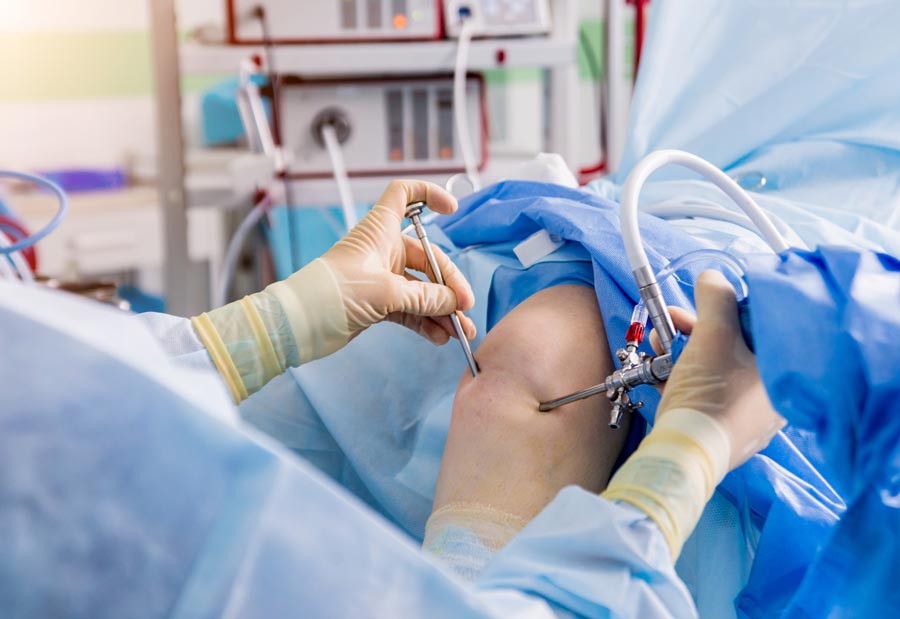
The patient will be shifted to the operation room and the anesthesia is administered before the procedure. The procedure is usually performed with the help of a diagnostic knee arthroscopy, in which a tiny camera called arthroscope is inserted into the knee through a small cut. The view of the arthroscope is transmitted to an external monitor. This will help the surgeon to see inside the injured joint and to check for the damage inside it.
Once the damage is identified, surgeon will replace the damaged ACL with the prepared graft. Surgeon will drill sockets or tunnels into your thighbone and shinbone to place the graft and will attach the new ligament to the bone using screws or other devices to hold it in place. At the end of the procedure, the incisions made will be covered with a surgical dressing.
What is the post-procedure care?
Soon after the surgery you will be in the recovery room until you get out of the anesthetic effect. In most cases, one can go home the same day of the surgery. You will be going home wearing a knee brace and which must be worn for the first 1 to 4 weeks. Before going home, you will practice walking in crutches which will help in preventing putting too much weight on your leg.
Your doctor will also give some specific instructions to control swelling and pain after surgery and for a speedy recovery. This includes:
- Medicines like opioids, non-steroidal anti-inflammatory drugs (NSAIDs), and local anesthetics are prescribed for the short-term pain relief after the surgery.
- RICE therapy: You may be advised to keep your leg elevated, apply ice to your knee, wear compression bands and rest as much as possible to control the pain and swelling around the area.
- Rehabilitation: Physiotherapy is a vital part for the speedy and healthy recovery. It will help to reduce the swelling, regain full range of motion and strengthen the muscles in the knee area. You will also be instructed to keep the incision dressings clean and dry.
One can return to sports and other activities when the full range of knee motion has been restored and there is no pain or swelling in the area.
What are the risks associated with surgical ACL reconstruction?
Some of the risks associated with the ACL reconstruction include:
- Any improper tissue procurement or sterilization techniques can cause infection after ACL reconstruction, which can be life-threatening.
- Allograft reconstruction is linked with the risk of viral transmissions including HIV and Hepatitis C.
- Bleeding and blood clots may occur in rare cases after the ACL reconstruction, which may lead to various other complications.
- ACL reconstruction may cause growth plate (located at the ends of bones in the arms and legs) injury in children which may result in shortened bones.
- Knee stiffness which affects the motion of knee joint.
Outlook (Prognosis)
An ACL reconstruction along with proper rehabilitation can promise a stable knee joint with its full range of motions. The success of therapy varies from person to person. Advanced surgical methods and focused rehabilitation will:
- Reduce the pain and stiffness around the area
- Allow you to return to sports and other activities that require a functioning ACL
- Protect the future damage to the knee joints
Sources
- ACL Reconstruction. https://www.mayoclinic.org/tests-procedures/acl-reconstruction/about/pac-20384598. Accessed on: 05-03-2020.
- ACL Injury: Does It Require Surgery?. https://orthoinfo.aaos.org/en/treatment/acl-injury-does-it-require-surgery/. Accessed on: 05-03-2020.
- ACL Reconstruction.https://medlineplus.gov/ency/article/007208.htm. Accessed on: 05-03-2020.
- ACL Reconstruction Surgery. https://www.ucsfhealth.org/education/acl-reconstruction-surgery. Accessed on: 05-03-2020.