Recently, Anna found a pea sized soft bump on her wrist. It’s not much painful but the unsightly appearance of the bump had impelled her to meet her family doctor. After examining, the doctor confirmed that it is a ganglion cyst, a common problem that should not cause much concern.
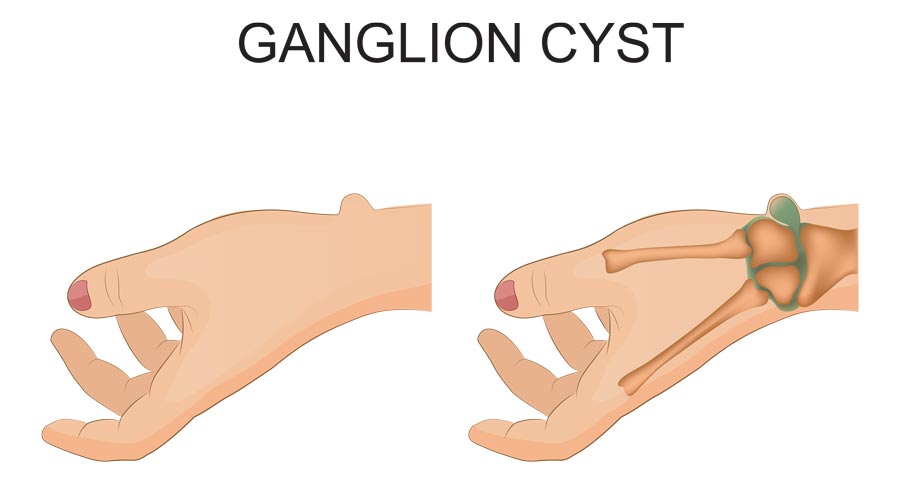
Ganglion cysts are noncancerous, fluid filled lumps that usually occur along the tendons or joints of the wrists or hands. The jelly like fluid present in the cyst is a thick lubricating fluid that is similar to one which is present in joints and around tendons.
What are the symptoms of Ganglion cyst?
The following are the characteristics of a ganglion cyst.
Occurrence: Ganglion cyst can occur anywhere on your body. However, they commonly develop along the tendons or joints of the wrists or hands. The second common location could be ankles and feet or other joints.
Appearance: Majority of the ganglion cysts are visible, however smaller ganglion cysts that are hidden under the skin may not be prominent. They are round or oval measuring around less than one inch in diameter. Sometimes their size may increase when the joint involved is used repetitively or may decrease and disappear or reappear.
Experience: Ganglion cysts are usually painless but mild pain may indicate that the cyst is pressing a nerve passing through the joint. It may also cause tingling, burning sensation and rarely muscle weakness when the cyst is connected to the nerve. It may also cause irritation while wearing the shoe, if it is present around.
What are the causes of Ganglion cyst?
The cause of ganglion cyst is usually unknown. They are more common in women than in men and usually affect people between ages of 40 to 70 years.
It is thought that they may arise from trauma which could be single major event or repetitive mild trauma. They may also occur due to arthritis known as mucus cysts, typically seen near joints of the fingers.
How is the ganglion cyst diagnosed?
Thorough medical examination is usually sufficient for diagnosis. It may include:
Medical history: Initially the doctor may review the medical history along with the symptoms regarding the onset of the cyst, changes in size or other associated symptoms like pain and tingling.
Physical examination: The lump is usually obvious and when pressed may move freely underneath the skin. The doctor may also apply pressure to identify any tenderness at the affected area. As the ganglion cyst is filled with fluid, the doctor may shine light through it to check if it passes through. This helps to identify whether the cyst is filled with fluid or solid mass.
Other diagnostic tests may be recommended that may help to rule out other conditions such as bone tumor or arthritis. They may include:
X-ray: X-rays are useful to obtain images of dense structures such as bones that are helpful in identification of underlying conditions like arthritis.
Ultrasound: Ultrasound is helpful in evaluating soft tissues of hand, wrist, feet or ankle. Images are produced using high frequency sound waves which helps identify ganglion cyst and to rule out other conditions like tumors.
Magnetic resonance imaging (MRI): The 2-or 3-dimensional images produced using both magnetic and sound waves provide a better view of the affected area. An MRI is also used to distinguish between cyst from tumor and also whether a ligament injury is associated with the cyst.
Aspiration: Aspiration is usually a confirmative test in which the fluid drawn out from the cyst using a syringe or needle is observed for its characteristic features like translucence, thickness and transparency.
How are ganglion cysts treated?
Various treatment options are available for treatment of ganglion cysts depending on how it affects the person. Majority of the cysts are painless that may not require any treatment. They may only need to be observed for certain period if they do not interfere with your daily activities. However, if the cyst is causing pain or interfering with walking or joint movement, the following treatment options may be considered.
Immobilization: Using a splint or brace to temporarily immobilize the area may help to shrink their size. This helps to release pressure on the nerves and in turn reduce pain. However, long-term use of brace or sprint is not recommended as they can make the muscles weak. As the pain decreases, muscle strengthening exercises proves helpful in regaining range of motion.
Aspiration: During this procedure, the area surrounded by the cyst is numbed and the fluid from the cyst is drained out using a needle or syringe. This procedure is usually recommended for the cysts located on the top of the wrist. However, in many cases that ganglion cyst returns as the root of the cyst remains intact.
Surgery: Surgery may be recommended if other procedures fail to work. Surgery involves in removing the cyst along with the stalk that attaches it to the joint or tendon. The rate of recurrence of the cyst is less in surgery when compared with aspiration; however there is always a chance of recurrence even after surgery.
Outlook
As ganglion cysts are harmless, there are fair chances to have a full recovery. However, as ganglion cysts may return after treatment, it may be necessary to undergo treatment more than once.
References
- https://www.mayoclinic.org/diseases-conditions/ganglion-cyst/diagnosis-treatment/drc-20351160
- https://orthoinfo.aaos.org/en/diseases--conditions/ganglion-cyst-of-the-wrist-and-hand/
- https://www.foothealthfacts.org/conditions/ganglion-cyst
- https://www.uchicagomedicine.org/forefront/orthopaedics-articles/that-bump-on-your-wrist-is-likely-a-ganglion-cyst