The way any equipment or machinery, that is subjected to wear and tear, with their prolonged use, the same happens with our bodies, especially our bones. As we turn older, our joints begin to wear out making it difficult to perform our regular activities, such as walking or bending due to stiffness or pain. The degenerative spine is one such condition that refers to gradual changes in our spine overtime leading to loss of its normal structure and function.
Our spine consists of vertebrae (individual bones) that are stacked one above the other to form vertebral column. These vertebrae are connected by sturdy intervertebral disks that acts as cushion and shock absorbers between the vertebrae. These discs are made up of a jelly-like material that is surrounded by a fibrous outer ring. Repeated strain and overuse of the back may result in degeneration of discs in the spine.
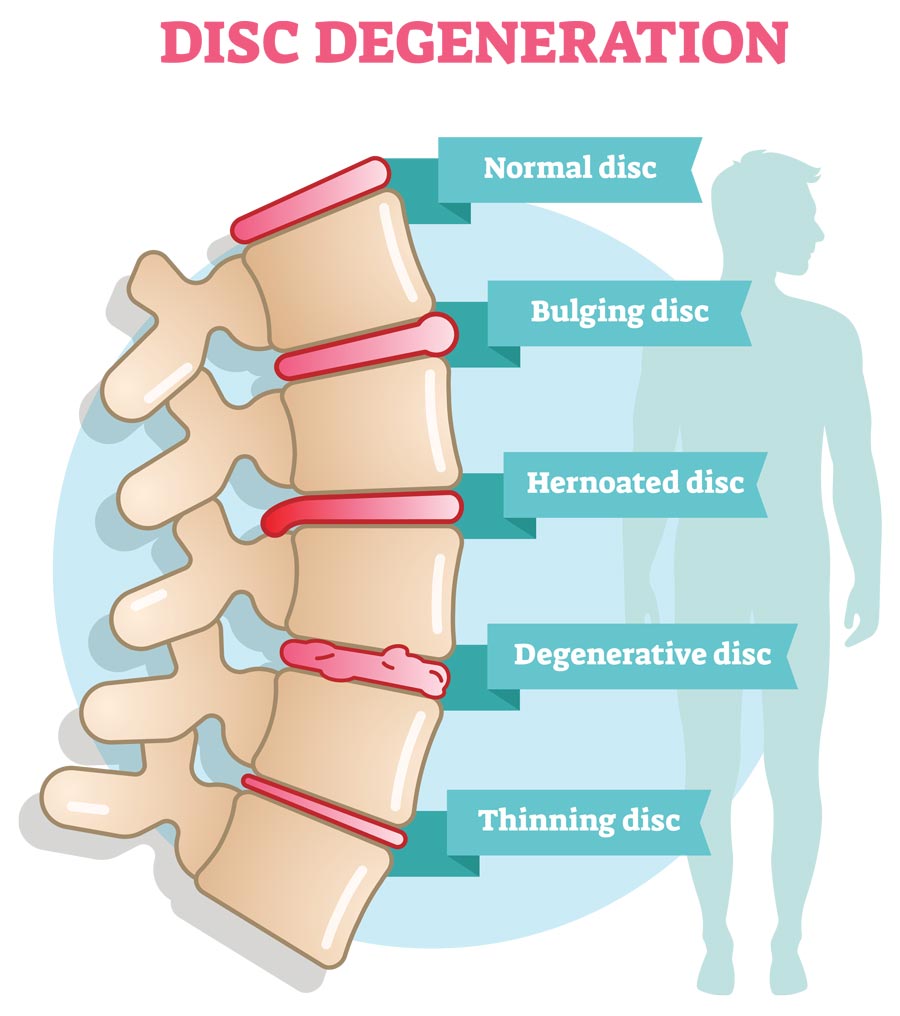
What are the causes for degenerative spine?
The common causes for degenerative spine include:
Drying out: As we age, the intervertebral disks may dry out and shrink making them unable to absorb the shock, the way they normally could.
Regular activities: Doing a lot of lifting or engaging in sports like hockey or weightlifting may cause overload and strain your spine. Such activities may increase your risk for bone degeneration.
Lifestyle: Poor nutrition, especially lack of vitamin D may lead to bone degeneration. Smoking and obesity also increases risk ofthe condition.
What are the symptoms of degenerative spine?
The symptoms of degenerative spine vary from person to person. Some people may not experience any symptoms while other do. When they occur, they are usually localized in your neck or lower back.
The common symptoms for degenerative spine include:
- Pain in your neck and lower back.
- Pain that may radiate to your arms and hands.
- Pain that may radiate to buttocks and thighs and may be accompanied with bladder or bowel incontinency.
- Pain that may worsen while sitting or sleeping; after lifting, twisting or bending.
- Pain that is sharp or continues for several weeks or months.
- Pain that may get better when you change your position or sleep.
- Pain that may cause muscle weakness, numbness or tingling sensation in your hands or legs.
How is the degenerative spine condition diagnosed?
The diagnosis of degenerative spine condition is based on your medical history and physical examination.
Medical history: During medical history, your doctor obtains details about your past spine injuries and your family history for similar problems. Details related to when the pain has started and the activities or positions during which it is aggravated are also considered.
Physical examination: During a physical examination, the physician may look for pain around your lower back or neck. He may also try to identify the positions that may cause pain, by asking you to perform different activities like walking or bending.
If the physician suspects degenerative spine, the following tests are recommended to confirm the diagnosis.
X-ray: X-rays provides images of your bones that help in assessing your spine anatomy, curvature and the alignment of the vertebrae. They are also helpful in determining abnormalities, such as narrowing of disc space, fractures, slippage, erosion or bone spurs (projections) that are associated with the condition.
Magnetic Resonance Imaging (MRI): MRI provides detailed images of soft tissues like discs, nerves, and spinal canal space. This helps in identification of damage in the nerves or decrease in the spinal canal space that may happen during spine degeneration.
Computed tomography (CT): A CT scan provides more architectural details of your spine. Some of them related to the condition may include osteoarthritis, spinal stenosis (narrowing of disc space) and other stages related to degeneration, such as endplate degeneration or sclerosis.
Myelography: This test helps in determining the abnormalities in your spinal canal. It helps in identification of bulging or slipping of the discs that may compress the nerves in the spine.
Other nerve conduction tests, such as electromyography (EMG) may be recommended to determine any damage to your nerves due to spine degeneration.
How is the degenerative spine treated?
The treatment mainly focuses on relieving symptoms and strengthening the muscles that are involved in supporting the back. It includes:
Physical therapy: In initial stages, physical therapy helps to relieve pain and improve range of motion. Once your pain is decreased, the physical therapist may recommend muscle strengthening exercises. He may also advise you to avoid certain activities that may increase strain on your spine.
Medications: Medications, such as ibuprofen or diclofenac may help in relieving your pain and inflammation.
Injections: Corticosteroid injections are recommended when physical therapy and medications fail to improve your condition. They may be injected directly into your muscle, nerve or fluid-filled area in your spine. They help in relieving pain and swelling.
Surgery: When all the above treatments fail to improve your condition even after using them for extensive period then surgical treatment is recommended. Surgery is done to remove the damaged part of the disc or the whole disc and replace it with an artificial disc. When there is severe degeneration, the physician may perform spinal fusion (a surgical procedure, which involves joining of bones with the help of screws or bone grafts) to ensure the stability of your spine.
What is the outlook for spine degeneration?
The outlook of the condition depends on your active role in thetreatment. It is essential to follow the recommended physical activity to improve your flexibility and strengthen your muscles that render better spine support. It is also important to modify or restrict the activities that may aggravate your symptoms. Maintaining healthy weight and avoiding smoking also proves beneficial.
References:
- https://www.arthritis.org/diseases/degenerative-disc-disease
- https://stanfordhealthcare.org/medical-conditions/back-neck-and-spine/degenerative-disc-disease/causes.html
- https://www.webmd.com/back-pain/degenerative-disk-disease-overview#2
- https://www.cedars-sinai.org/health-library/diseases-and-conditions/d/degenerative-disc-disease.html
- https://www.mayoclinic.org/diseases-conditions/osteoarthritis/expert-answers/arthritis/faq-20058457
- https://my.clevelandclinic.org/health/diseases/16912-degenerative-back-conditions
- https://www.columbiaspine.org/condition/degenerative-spine-conditions/
- https://health.ucdavis.edu/spine/specialties/degenerative.html