Soft tissues are the extra skeletal tissues of the body that surround organs and other anatomic structures. Soft tissues include muscles, fats, blood vessels, nerves, tendons and the lining of the joints. When these cells start to grow in a rapid rate, they may form lumps in some areas, which can lead to cancer of the soft tissues or sarcoma.
What is soft tissue sarcoma?
These are rare type of cancers that develop in the soft tissues and bones, commonly found in the arms, legs, chest or abdomen. In this condition the soft tissue cells grow and divide uncontrollably, forming a huge mass called tumors, which may put pressure on the nearby organs.
The tumors that originate within the soft tissues are called as primary cancers of soft tissues. Some of these cells may enter the bloodstream and invade the surrounding tissues, forming cell masses known as secondary tumors.
Soft tissue sarcomas can be cancerous (malignant) or non-cancerous (benign). Individuals belonging to any age group, who have a weak immune system, and are exposed to radiations regularly, commonly develop primary soft tissue sarcoma.
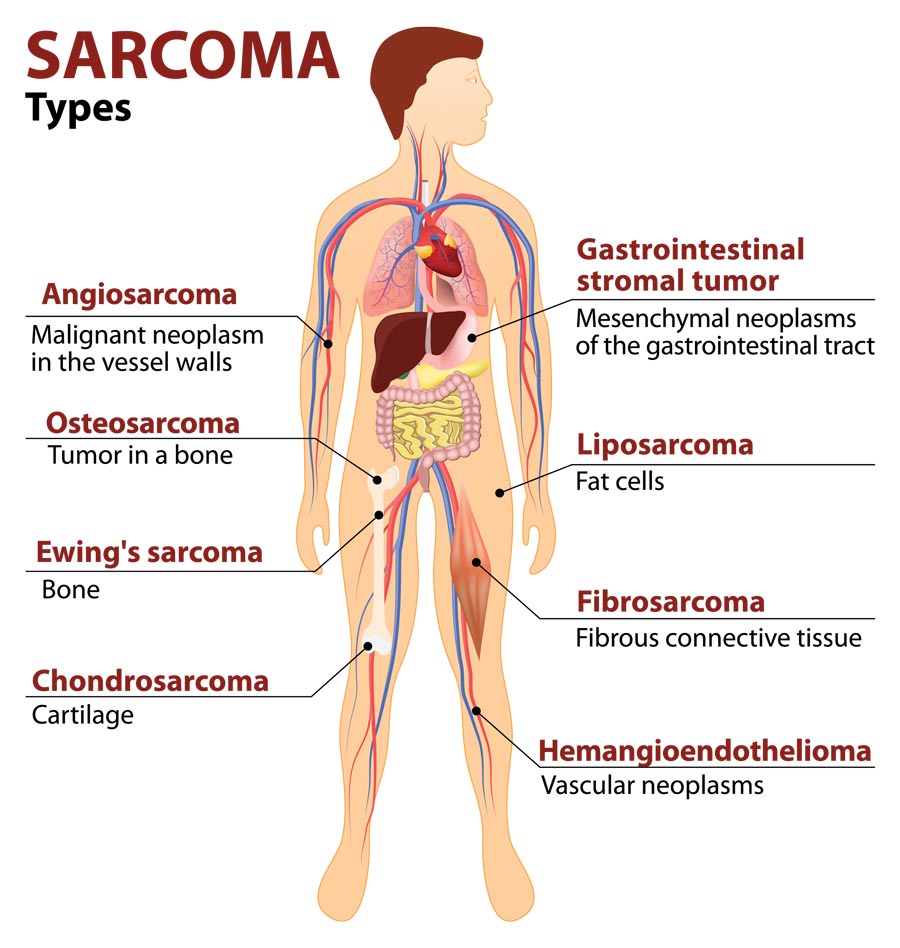
What are the signs and symptoms of soft tissue sarcoma?
Signs and symptoms of soft tissue sarcoma vary from person-to-person. However, most early stage sarcoma does not present any symptoms.
An important sign of soft tissue sarcoma is a lump or swelling which may or may not cause pain. Depending upon the location of sarcoma, the symptoms may vary:
- Sarcoma of the bones will cause a limited range of motion in a joint
- Skin sarcoma will cause skin lesions
- Sarcomas in the abdomen may cause abdominal pain, vomiting or constipation
- Sarcomas in the uterus may cause vaginal bleeding and/or abdominal pain
Fever of unknown origin and troubled breathing is also considered as symptoms of soft tissue sarcoma. However, the sarcoma may not present any symptoms until they grow and spread to the neighboring tissues.
What are the causes and risk factors of soft tissue sarcoma?
The exact cause of soft tissue sarcoma is not clear. Generally, errors in the DNA causes the cell to divide in an uncontrollable rate. These abnormal cells will accumulate to form tumor and spread to other parts of the body.
Some of the risk factors of primary cancers of the soft tissue are:
- Genetic disorders like Von Recklinghausen’s disease (neurofibromatosis), Gardner syndrome, Werner syndrome, nevoid basal cell carcinoma syndrome, Li-Fraumeni syndrome or retinoblastoma, etc. may increase the chance of developing a soft tissue sarcoma.
- Exposure to potent chemicals like vinyl chloride monomer (a substance used to make types of plastics), arsenic, dioxin etc. may increase the risk of sarcoma.
- History of radiation exposure or other cancers also increases the chance of getting soft tissue sarcoma.
- Old people are more prone to soft tissue cancer than young individuals; however, this sarcoma can be seen in all age groups.
How is soft tissue sarcoma diagnosed?
If you experience any symptoms of sarcoma, seek immediate medical attention. An early diagnosis increases the chance of successful treatment.
Your doctor will examine the suspected lumps and ask about your health, family medical history to learn if you have any risk factors. Other diagnostic tests are as follows:
- Imaging tests: The tumors can clearly show up on imaging tests like X-rays, MRI scans, Computed tomography (CT) scan, etc. These images can determine whether the tumor is benign or cancerous.
- X-ray: X-ray images can diagnose tumors under the skin, in the bones or other organs. X-rays of the lungs are commonly recommended as they are the most common site for metastasis of soft tissue sarcomas.
- Computed tomography (CT or CAT) scan: A CT scan creates a 3-dimensional image by using x-rays to get cross-sectional images. This scan helps to measure the size of tumor and understand its spreading pattern. CT scan is preferred to diagnose tumors in the areas like chest, abdomen, lungs, etc.
- Magnetic resonance imaging (MRI): MRI provides a clear picture of tumors and the extent of the tumor without any exposure to radiations. They are often used to evaluate sarcomas in the arms or legs. MRI scan also helps to determine whether a sarcoma can be removed with surgery or not.
- Positron emission tomography (PET) scan or PET -CT scan: A PET scan is usually combined with a CT scan to create 3-dimensional pictures of organs and tissues inside the body. PET scan is used to detect cancer cells in the early stages and determine whether the cancer has spread in the body.
- X-ray: X-ray images can diagnose tumors under the skin, in the bones or other organs. X-rays of the lungs are commonly recommended as they are the most common site for metastasis of soft tissue sarcomas.
- Biopsy: The diagnosis of sarcoma is confirmed by biopsy tests. For this test, sample cells from the suspected lump are taken and examined under microscope. The nature of cells, its size, etc. are examined to confirm the diagnosis.
There are different types of biopsies, and the commonly preferred methods are:
- Core needle biopsy: Here the sample is collected from the area using a needle-like instrument.
- Surgical biopsy: When the needle biopsy is challenging or a larger sample of tissue is needed, a surgical biopsy may be recommended. In this method, the suspected lump or area is cut to collect the sample or to remove a small part or the entire mass of tumor.
- Core needle biopsy: Here the sample is collected from the area using a needle-like instrument.
What are the treatment options for soft tissue sarcomas?
The treatment method for soft tissue cancer depends on several factors, including:
- The location and type of sarcoma
- Stage of the tumor
- Your general health condition and possible impacts on the body.
As sarcoma is rare, it is usually treated with a combination of therapies like surgery, chemotherapy and radiation:
- Surgery: Surgery is the common treatment option for soft tissue sarcoma, where the tumor and the surrounding tissues are removed surgically. The surgeon's goal is to obtain a clean border around the tumor with no visible tumor cells nearby.
In case the tumor is large and involves major blood vessels and nerves, surgeons will remove that whole area to control the tumor. This is common in arms and limbs; the surgical removal of limb is called as amputation. - Chemotherapy: Chemotherapy is a treatment that uses medications to prevent the growth and spread of cancerous cells. It is usually preferred when the sarcoma has already spread. It may be given either alone or in combination with other treatments like surgery, radiation therapy, or both. The most commonly used drugs are ifosfamide, doxorubicin, epirubicin docetaxel, methotrexate, etc.
This therapy also affects the surrounding normal healthy cells and cause side effects like fatigue, risk of infection, nausea and vomiting, hair loss, loss of appetite, and diarrhea. The side effects of chemotherapy depend on the individual and the dose administered. These effects usually disappear over time when the treatment is stopped, while some may persist for a long time or even be permanent. - Radiation: Radiation therapy involves the use of high energy X-rays or other particles to destroy or kill the cancerous cells. This method is generally used as an adjuvant treatment before surgery to shrink the tumor or after surgery to destroy remaining cancer cells.
The radiation therapy is basically of three types: external beam therapy, internal beam therapy and intraoperative beam therapy.
- External beam therapy: In this type, the radiation is delivered from a distant source, outside the body. The common radiation sources are X-ray beam machines and proton beam machines. This is used in the treatment of tumors in head and neck area, breast, lungs, colon and prostate.
- Internal beam therapy: In this type, the radiation is delivered as near as possible to the tumor site. It is also called as brachytherapy, where the radiation pellets are placed directly into the affected area using a thin tube called catheter. This therapy will minimize the risk of side effects as the radiation is delivered precisely to the cancer cells. This therapy is effective in the treating cancers of uterus, rectum, vagina and eye.
- Intraoperative beam therapy: In this type of therapy, an intense radiation given directly to the target area during a surgery after the tumor is removed. This will act as a shield for the surrounding healthy cells and protect it from damage.
- External beam therapy: In this type, the radiation is delivered from a distant source, outside the body. The common radiation sources are X-ray beam machines and proton beam machines. This is used in the treatment of tumors in head and neck area, breast, lungs, colon and prostate.
Outlook
Soft tissue sarcomas are primary tumors that develop in any of the soft tissues in our body. If your cancer is likely to respond to the treatment, your doctor will estimate the risk for the type and stage of the cancer and will explain the prognosis of your treatment. If the treatment fails to control the division of cancer cells, the prognosis will be less favorable. Once the active treatment is completed, your doctor will keep a track of the recovery pattern by regular checkups and medications to ensure that the cancer will not reoccur and to manage the side effects and maintain overall health.
The prognosis for people with soft tissue sarcoma is better in the cases where the cancer is diagnosed early than cases that are diagnosed at a later stage.
Sources
- Sarcoma, Soft Tissue. https://www.cancer.net/cancer-types/sarcoma-soft-tissue. Accessed on: 27-02-2020.
- All about soft tissue sarcoma. https://www.oncolink.org/cancers/sarcomas/sarcoma-soft-t-issue/all-about-soft-tissue-sarcoma. Accessed on: 27-02-2020.
- Soft Tissue Sarcoma. https://www.cancer.org/cancer/soft-tissue-sarcoma.html. Accessed on: 27-02-2020.
- Soft Tissue Sarcoma.https://www.mayoclinic.org/diseases-conditions/soft-tissue-sarcoma/symptoms-causes/syc-20377725. Accessed on: 27-02-2020.