Your shoulder joint is the most flexible joint in your body, to which the range of flexibility of your arms could be attributed. However, its greater range of movement makes it the most common joint for dislocation.
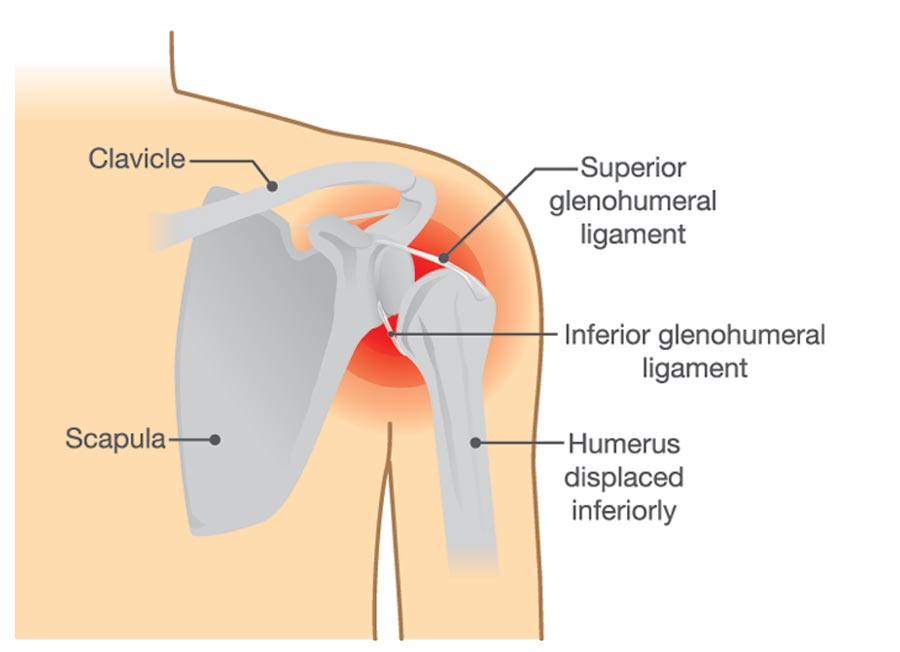
Your shoulder joint consists of three bones namely clavicle (collarbone), scalpula (shoulder blade) and humerus (upper arm bone). Your shoulder blade has a cuplike socket in which the ball shaped head of your upper arm bone (humerus) fits in. This arrangement helps us in performing different kinds of actions such as lifting, rotating or reaching our arm over our head. When the ball is slipped or forced out of the socket, it is known as shoulder dislocation. The dislocation could be partial in which the ball only moves partially out of the socket or complete when the ball is completely out of the socket.
Once you have shoulder dislocation, you are more likely to have repetitive episodes of dislocation in future. When a shoulder joint remain dislocated for several days, it is called chronic dislocation.
What are the types of shoulder dislocation?
Depending on the direction of dislocation, shoulder dislocations are classified as:
- Anterior dislocation: The head of the humerus shifts forward, towards front of your body.
- Posterior dislocation: The head of the humerus shifts towards back of your body.
- Inferior dislocation: A rare type in which the head of the humerus is shifted downwards.
Anterior dislocation is most common that accounts for about 95% of all dislocations.
What are the symptoms of shoulder dislocation?
The symptoms of shoulder dislocation include:
- Intense pain in the shoulder
- Swelling
- Bruising or abrasion
- Inability to move the shoulder
- Prominent deformity of the shoulder
- A hard knob (dislocated humerus top) under the skin near the shoulder
- Numbness or tingling sensation that radiates to your neck or down your arm, hand or fingers
- Muscle spasms around your shoulders
What are the causes or risk factors for shoulder dislocation?
The common causes for shoulder dislocation include:
- Accidents: A sudden blow to your shoulder during an accident may lead to dislocation.
- Sports injuries: Shoulder injuries in contact sports like football, hockey, volleyball and others like gymnastics or skiing may cause shoulder dislocation.
- Falling: Falling on an outstretched arm or on your shoulder leads to shoulder dislocation.
- Seizures or electric shocks: Intense muscle contractions during electric shock or seizures can dislocate the shoulder joint.
However, weakness and degeneration of the soft tissues around the shoulder joint, associated with increased age; alcoholism or multiple traumas in younger people remain as the mainstay for chronic shoulder dislocation along with trauma.
How is shoulder dislocation diagnosed?
The preliminary step in diagnosis includes a thorough physical examination. The physician may examine both the shoulders (injured and uninjured) and compare them for any apparent deformity. He may press around the affected area in an attempt to check for tenderness and also looks for other symptoms like bruising or swelling at the joint. He may also check for restriction in movement of the joint. By gently pressing around the area he may try to locate the displaced head of the humerus under your skin. He may also check for numbness in your upper arm.
During the physical examination if the physician suspects shoulder dislocation, he may recommend an X-ray of your shoulder joint to confirm the diagnosis. This helps in determining the damage happened to the shoulder joint and other bone injuries.
What are the treatment options for dislocated shoulder?
The treatment line for elbow dislocation includes:
Closed reduction: This is a procedure in which your physician tries to adjust (manipulate) your arm externally, such that it may return to its normal position. Depending on your pain and swelling, you may be given muscle relaxants to relax your shoulder muscles before starting the procedure. Once the joint is back into position, you should immediately feel relieved from severe pain.
Surgery: Surgery could be an option when your nerves or blood vessels are damaged along with dislocated shoulder. It may also be recommended when you have recurrent shoulder dislocations due to weak shoulder joints or ligaments even after following proper rehabilitation and strengthening regime.
Sling: Special splints or slings are used to immobilize your joint in place. You may have to wear it for several days or weeks depending on your condition.
Medications: Drugs such as ibuprofen, naproxen or acetaminophen may help in relieving from pain.
Rehabilitation: Once the pain and swelling have improved, your physician may refer you to a physical therapist. Following rehabilitation program helps in restoring the range of motion, strength, and stability of your shoulder joint. You may need to continue doing some exercises to avoid future dislocations.
Outlook
It is important to seek immediate medical attention when you suspect a dislocated shoulder. Once the displaced shoulder is back in its place, you may be able to move your shoulder immediately, however obtaining full range of motion may take time. Following proper medical advice is important for resuming your activities. Involving in activities before complete recovery may increase the chances for dislocating your shoulder again. Being cautious to avoid falls, taking protective measures while playing contact sports and exercising regularly helps you to prevent shoulder dislocations to some extent.
- https://www.mayoclinic.org/diseases-conditions/dislocated-shoulder/diagnosis-treatment/drc-20371720
- https://www.health.harvard.edu/a_to_z/shoulder-dislocation-a-to-z
- https://orthoinfo.aaos.org/en/diseases--conditions/dislocated-shoulder/
- https://medlineplus.gov/dislocatedshoulder.html
- https://bmcsportsscimedrehabil.biomedcentral.com/articles/10.1186/1758-2555-2-15