Hand injuries are common consequences of a sudden fall, or accidents that often results in a persistent or reoccurring pain. It may be because one or more bones in your hand might have fractured. If the impact of the accident is gradual, then the bone injury may be partial or not painful enough to seek immediate attention. But if your injury is from an immense force, it may result in a broken bone or fracture. Furthermore, when these fractures are not diagnosed early, it may significantly impact the quality of victim’s life.
What is hand fracture?
A hand fracture is a break or crack in one or more bones in the hand. A fracture occurs when high force is applied to any bone causing it to break. There are several bones that together make up the supporting framework of the hand, which include phalanges (small bones that form the thumb and fingers) and metacarpals (five bones that are located in the palm of the hand). Any break in one of these small bones will result in fracture of the hand.
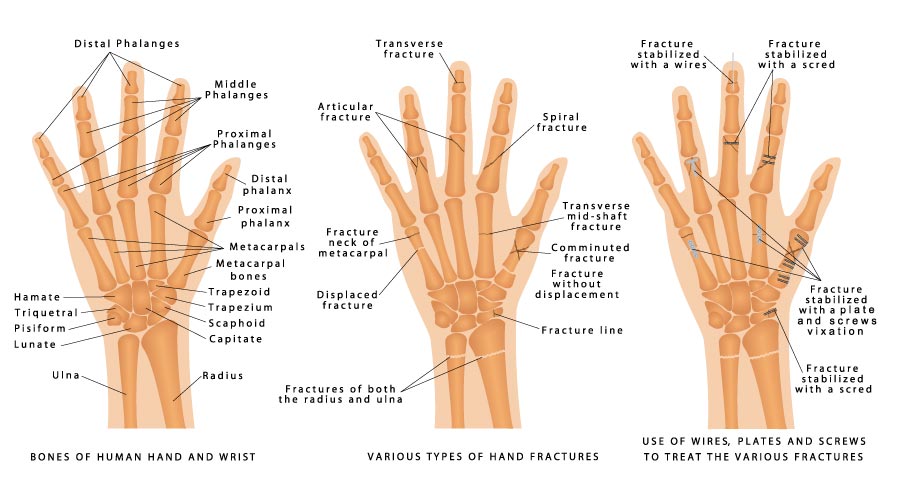
How can you identify a hand fracture?
Common signs and symptoms of a hand fracture may include:
- Swelling
- Tenderness or pain
- Deformity of hand
- Inability to move fingers
- Numbness in your hand or fingers
How do you get a fracture in your hand?
Fractures can occur from a fall, a crush injury (squeezed between two heavy objects), a twisting injury and from sports or motor vehicle accidents; the fractures from motor vehicle accidents require immediate medical attention. The risk of a broken hand may increase if you are a sports person or have osteoporosis (a condition where the bone is weak, brittle and the bone mass is reduced).
How is a hand fracture diagnosed?
When you suspect that your hand is broken, doctor will examine your hand for deformity, mobility, and strength. Usually, X-ray studies are carried out to determine whether a bone is broken or not, based on which an appropriate treatment is decided by the physician.
Sometimes, X-ray fails to detect some subtle fractures. If a fracture is suspected based on the symptoms and the cause, tests like CT scan and MRI’s can be helpful in detecting the small fractures and deep injuries.
What are the treatment options available?
The treatments of a broken hand include surgical and nonsurgical methods.
Nonsurgical treatment is recommended when the fracture fails to lineup in its acceptable position. Your doctor will realign and manipulate the fragmented bones back into the position without making any incision, which is known as closed reduction. The injured hand is immobilized using a cast, splint or brace.
Surgical treatment is recommended when the non-surgical treatment method fails to stabilize the fractured bone fragments. Here the doctor will make an incision to reposition the broken bone fragments to its normal alignment. The common surgical methods include:
- Open reduction and internal fixation: The surgeon will make an incision to re-align the bone and hold it together by using wires and pins.
- Bone grafts: The injured bone is repaired by replacing the bone with another bone from any part of the body or from a donor (grafting). Bone grafting will give improved stability to the joint.
After the surgical procedure, the injured area will be covered with splints or cast to avoid unnecessary movements and enhance healing. As the fractured bone is stable, physiotherapy is recommended to restore the normal motion of the hand.
Self-care during and after healing
After the surgery, you may experience pain or swelling around the area. The swelling can be controlled by applying ice pack to the injured area or by keeping the hand in an elevated position (above the level of heart). Doctor may prescribe painkillers for the short term relief from pain after the procedure.
The physician will give you instructions about the time and during you should wear the splint; he or she will tell you to keep the splint clean and dry.
Your doctor will recommend a range of motion exercises and to resume your activities after removing your splint or casts.
How to avoid getting hand fracture?
In most cases, it is impossible to prevent the unforeseen events which can cause a broken hand. To prevent some of the causes, you should strengthen your bones by exercising and consuming adequate nutrients. Also, be alert when there are chances of falls or accidents while doing some physical activity.
Source
- Hand Fractures. https://orthoinfo.aaos.org/en/diseases--conditions/hand-fractures. Accessed on:12-02-2020.
- Broken hand . https://www.mayoclinic.org/diseases-conditions/broken-hand/symptoms-causes/syc-20450240. Accessed on: 12-02-2020.
- Broken hand. https://handcare.assh.org/Anatomy/Details-Page/ArticleID/27972/Broken-Hand. Accessed on: 12-02-2020.
- Hand fracture – aftercare. https://medlineplus.gov/ency/patientinstructions/000552.htm. Accessed on: 12-02-2020.