The hip is a ball-and-socket joint that allows movement, stability, and bears weight of the body.
Any sudden injury or accident may break the hip bones and result in hip fracture. Broken hip or hip fracture at any age could be a life-threatening condition.
What is a hip fracture?
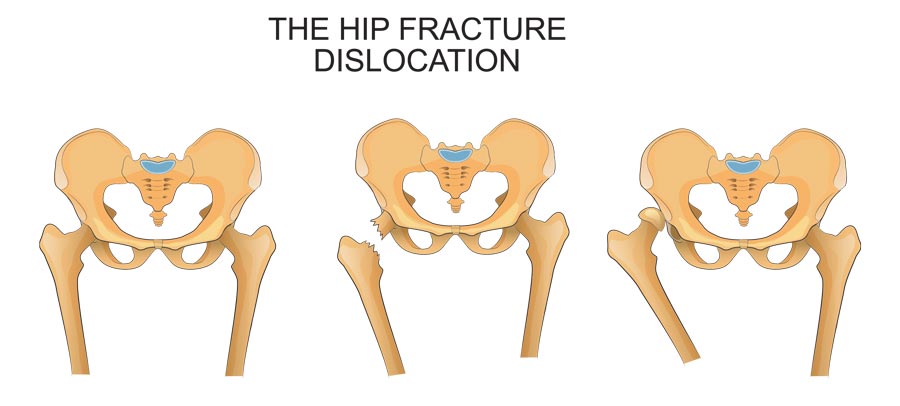
Hip fracture is a crack or breakage in the upper portion of the thighbone (femur). The severity of the fracture depends on the magnitude of force causing the injury. Depending on the affected region, hip fractures can be of the following types:
- Intracapsular fractures
- Intertrochanteric fractures
- Subtrochanteric fractures
What are the symptoms of a hip fracture?
Some of the symptoms of a hip fracture are:
- Pain and discomfort.
- Bruising and swelling around the hip.
- Inability to stand or bear weight on the leg.
- Inability to lift or turn the leg.
- Outward turning of the injured leg.
- Shorter appearance of the injured leg compared to the other leg.
What are the causes and risk factors of a hip fracture?
A bad fall is the main cause of a hip fracture. Also, an accident or other such traumas which cause a direct blow to the hip can lead to a hip fracture.
Medical conditions, such as osteoporosis, tumour, or stress injuries can weaken the bones and increases their susceptibility to breakage.
Women are at an increased risk of a hip fracture than men. This is due to higher chance of osteoporosis (condition that causes weak and brittle bones).
Other risk factors for a hip fracture are:
- Old age (above 65 years)
- Being underweight
- Family history of osteoporosis
- Calcium and vitamin D deficiencies
- Lack of physical activities or exercises
- Alcohol addiction and smoking
Distance runners and ballet dancers may also develop thin cracks on hips due to stress on the bone.
How is a hip fracture diagnosed?
When a patient complains of hip pain associated with a fall or a trauma, the doctor may suspect a fracture.
An x-ray may be ordered to detect the exact location. When X-rays fails to detect the exact location, then MRI scan may also be ordered. MRI scan can detect incomplete fractures and hidden fractures. If an MRI is not suitable for the patient’s medical condition, a CT scan may be recommended. However, a CT scan is not as sensitive as an MRI scan.
What are the treatment options?
Surgical repair or replacement is the only choice of treatment in hip fracture. The type of surgery depends on the patient’s age and overall health conditions
Surgical procedures include:
Internal repair using screws: In this method, metal screws are inserted to hold the broken bones together and allow healing. In some cases, screws are fixed to a metal plate that runs down the thighbone (femur).
Hip replacement: It is a procedure, in which the damaged part of the hip joint is replaced with a prosthesis (artificial joint). It is of 2 types:
- Partial hip replacement: Involves removal and replacement of ball of the hip joint.
- Total hip replacement: Involves removal and replacement of upper femur and socket of pelvic bone.
Surgery may be followed by physical therapy to strengthen and improve the mobility of the bone.
Outlook
The time for recovery depends on the type of procedure. If the broken bone is secured with pins and screws, the person can start walking immediately after the surgery. However, a cane or a walker should be used after 6-8 weeks.
Recovery from a hip-replacement surgery takes around 12 weeks or more. Nearly 25% of old people with hip fractures become dependent on others to carry out their daily activities even after recovery. This is mainly due to co-existing medical conditions and the complications following a hip fracture.
The best way to prevent hip fracture is to avoid falls by taking necessary precautions:
- Using canes, sticks, or crutches to assist in walking.
- Using hip protectors to reduce the impact of a fall, especially in older people.
- Checking for hazards at home, such as a loose carpet.
- Performing exercises to improve balance.
Also, increasing the strength of the bones helps in preventing hip fractures. The following are ways to improve bone strength:
- Take adequate calcium in the diet.
- Get adequate vitamin D through food and sunlight.
- Carry out physical activities which can increase the bone strength.
- Quit tobacco and alcohol consumption.
- Take medicines as prescribed by the doctor to improve bone density.