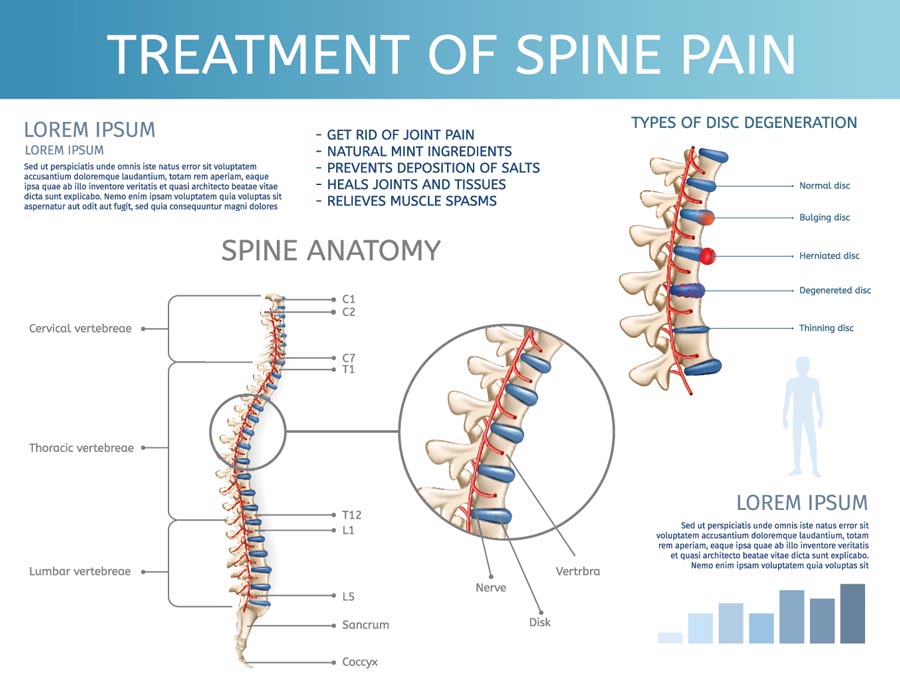
Your backbone provides support and structure to your body. It is also flexible enabling us to move and bend freely. Its flexible nature is attributed to its structural arrangement, where the vertebrae (individual bones) are stacked one above the other between which intervertebral discs are present acting as cushions.
Sometimes, the vertebra may slip or shifts from its position over to the next vertebra. This condition is known as spondylolisthesis. Spondylolisthesis is derived from a Greek word where ‘spondy’ refers to vertebra, and ‘listhesis’ refers to movement. It may occur at any age, but commonly seen in young athletes and aged population.
What are the symptoms of spondylolisthesis?
The symptoms of spondylolisthesis may vary from mild to severe; however people with spondylolisthesis often do not have any noticeable symptoms.
The symptoms, if they occur may include:
- Pain in the lower back.
- Stiffness in back.
- Pain radiating to buttocks, and back of thighs.
- Muscle spasms in hamstrings (muscles in the back of thigh).
- Pain that aggravates with activity and improves with rest.
- Difficulty in standing and walking.
When the slipped vertebra compresses a nearby nerve, it may lead to
- Pain radiating to your legs and foot.
- Numbness or tingling sensation in the legs and feet.
- Weakness in legs.
What are the causes of the spondylolisthesis?
The following are types of spondylolisthesis that are categorized depending on their underlying cause. They include:
Degenerative spondylolisthesis: Most common form of spondylolisthelis due to age related wear and tear of discs between vertebrae, making them dry and shrinks in size. This flattened disc may cause the vertebrae to move forward onto the vertebra below it.
Congenital spondylolisthesis: Birth defects resulting in abnormal bone arrangements, increasing the risk for slippage.
Isthimic spondylolisthesis: It occurs due to fracture in pars interarticularis (small bone connecting the two joints at the back of your spine), which may in turn weaken the bones leading to slippage.
Traumatic spondylolisthesis: A sudden injury or trauma may lead to fractures in spine and slippage.
Pathological spondylolisthesis: Conditions, such as osteoporosis, arthritis, infection or tumor may also lead to spondylolisthesis.
How is spondylolisthesis diagnosed?
The diagnosis usually includes medical history and a physical examination. Details related to your regular activities, such as your general health; symptoms and involvement in sports are reviewed. During physical examination, the physician may examine your back for areas of tenderness. He may ask you to raise your leg and walk to observe for any limitations due to pain or stiffness. He may also recommend other imaging tests to confirm the diagnosis. They may include:
X-rays: X-rays helps in obtaining the images of dense structures, such as bones. Images may be obtained from various angles to view the alignment of vertebrae and to identify any fractures. X-rays obtained from sideways may help in determining the degree of forward slippage.
Computed tomography (CT): A CT provides more detailed images of the bones that help in identifying the fractures and slippage.
Magnetic resonance imaging (MRI): MRI provides detailed images of the soft structures in the body. It helps to identify any damage in the discs that is causing spondylolisthesis or whether the slipped disc is pressing on a spinal nerve.
How is spondylolisthesis treated?
The primary goal of the treatment is to reduce pain, stabilize spine, and to improve person’s ability to resume the daily activity. Initially, the treatment is non-surgical and majority of people will improve their condition with this approach. However, severe spondylolisthesis may require surgery.
The treatment may include:
Rest: It is recommended to refrain from sports and other activities until the pain subsides.
Medications: Using non-steroidal anti-inflammatory drugs (NSAIDs) such as ibuprofen or naproxen may help to relieve back pain and inflammation.
Injections: Steroid injections such as cortisone may also provide relief from severe pain and inflammation.
Physical therapy: Exercises that help in stabilizing your spine are helpful. They include strengthening of your back and abdominal muscles. Specific exercises involved in stretching your muscles, such as hamstrings muscles to reduce muscle stiffness.
Brace: Sometimes a brace may be recommend to limit movement of the spine or to help in healing a recent fracture in the pars interarticularis.
Surgery: Surgery is usually recommended, if non-surgical options fail to provide pain relief or if the vertebra continues to slip. The main goal of the surgery is to relieve pain and to stabilize spine. Surgery involves spinal fusion of the damaged vertebrae, to limit their movement and reduce the related pain. Instruments such as rods, screws or bone implants may be used to hold the vertebra as the fusion heals. If the nerves are compressed due to slipped vertebrae, your physician may perform a procedure known as nerve decompression to relieve pressure on the nerves before fusing the vertebrae.
What is the prognosis of spondylolisthesis?
Recovery is based on your age, medical conditions and surgical approach. Majority of the patients are relieved from pain and other symptoms after treatment. Your physician may recommend returning to the activities based on your healing. However, you need to avoid strenuous activities, such as running, gym exercises, etc for about three to six months. Once the physician ensures complete recovery, he may suggest strengthening and stretching exercises for your back and abdominal muscles that may prevent further injury. Regular exercise and change in physical activities are the mainstay for people with spondylolisthesis.
References
- https://orthoinfo.aaos.org/en/diseases--conditions/spondylolysis-and-spondylolisthesis
- https://www.spine.org/KnowYourBack/Conditions/Degenerative-Conditions/Lumbar-Spondylolisthesis
- https://my.clevelandclinic.org/health/diseases/10302-spondylolisthesis/management-and-treatment
- https://medlineplus.gov/ency/article/001260.htm
- https://www.healthdirect.gov.au/spondylolisthesis