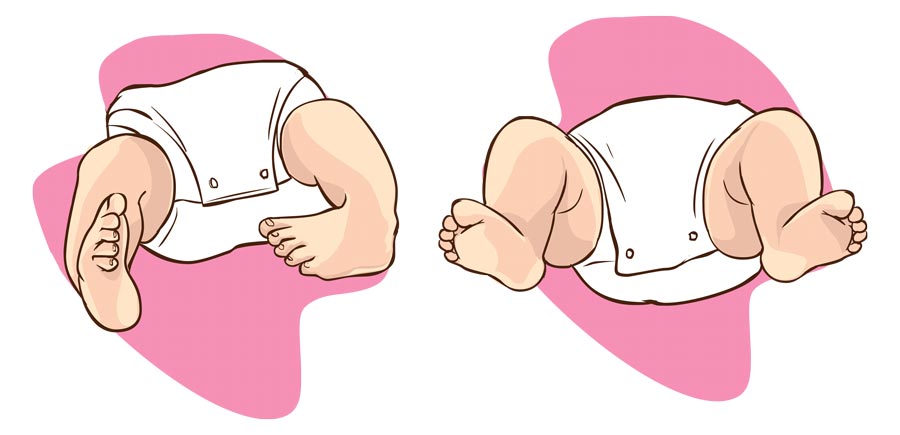
Clubfoot is a condition found in infants where the foot or feet appears to be rotated internally at the ankle area. The soles of the feet face each other as they are turned inwards. This is a congenital deformity, which is also called talipes equinovarus (TEV) or congenital talipes equinovarus (CTEV). In almost 50% of the cases, both the feet of the newborn is affected.
Clubfoot
In clubfoot, the tissues connecting the bones and muscles are shorter than normal. As a result, the baby’s foot is twisted out of shape and appears to point downwards. Clubfoot is a common congenital defect in an otherwise healthy baby. This condition may be mild or severe. About half of the children who suffer from this condition, have it in both the feet. It makes harder to walk normally, so the doctor may advise to treat it soon after birth.
Risk factors of Clubfoot
Clubfoot is considered a “multifactorial trait,” which means that there are many factors involved in causing this birth defect. It may be contributed by both genetic and environmental factors. Some of the potential risk factors are described below:
- Family history- If either of the parents or one of the other children has clubfoot, there are greater chances of the baby developing the same.
- Environmental conditions- Antenatal maternal smoking also increases the baby’s risk of having clubfoot.
- Congenital deformities- Babies with clubfoot are more prone to developing congenital abnormalities like spina bifida where the spine and spinal cord do not develop properly.
- Less amniotic fluid- If there is too little amniotic fluid surrounding the baby in the womb, chances are that the baby will develop clubfoot.
Symptoms of Clubfoot
If your child has clubfoot, here’s what it might appear like:
- The top of the foot appears to be twisted inward and downward, with the heel pointing inside.
- The feet are almost having an upside down appearance.
- The calf muscles may be underdeveloped in the affected foot.
- The length of the affected foot might be less.
There is no pain or discomfort associated with this condition.
Complications arising due to Clubfoot
There may not be any problems with your child until the time he or she begins to stand and walk. With proper treatment the walk can be restored to almost normal. There may be some problems faced by the child as in:
- Movement- The affected foot may not be very flexible.
- Leg length- The length of the affected leg will be slightly less, but usually this does not impair movement.
- Calf size- The length of the calf muscles on the affected foot may be smaller than on the normal side.
- Shoe size- The affected foot may be up to 1 ½ shoe size smaller than the unaffected foot.
If this condition is left untreated, it can lead to complications as described below:
- Abnormal gait- Your child may find it difficult to walk on the sole of the foot as the ankle is twisted in this condition. To overcome this difficulty, he or she may walk on the balls of the foot or on the outer border of the foot.
Other problems stemming from clubfoot are underdeveloped calf muscles, leading to an abnormal walk, and this can further lead to callosities and sores on the outer border of the foot
Diagnosis of Clubfoot
The doctor can easily identify clubfoot from its appearance, based on the shape and positioning of the newborn’s foot. Sometimes, an X-ray is performed to know the severity of the condition and to indentify if the cause is due to abnormal bony fusion.
Treatment of Clubfoot
The treatment usually begins in the first week or two following the birth as the joints and tendons are very flexible at this stage. Treatment is done to improve the alignment of the affected foot and help the child to walk comfortably when the time comes. The treatment includes:
The grandmother or the mother is taught to gently stretch the foot, the stretches are specifically taught to improve the alignment, skin is gently massaged so that it can a take a plaster cast if it becomes necessary.
Stretching and casting (Ponseti method)-This is the most common method for treating clubfoot. The doctor repositions the affected foot and places it in a cast. The cast is removed and reapplied once a week for several months, each time a specific part of the deformity is corrected. Many children get full correction with only a minor shortening of the tendocahilles, which is corrected by, a minor surgery in the outpatient department.
The child need to do stretching exercises to improve the strength and mobility. The use of special shoes and braces full time for three months and at nights and while taking naps up to three years is recommended.
Surgical intervention- When non operative methods fails, surgery may be required where the tendons and ligaments are lengthened to reposition the affected foot. After surgery, the child would have to use a cast for two months and wear braces for a year so that the condition doesn’t recur. .