The shoulder joint is formed by the upper arm (humerus), shoulder blade (scapula), and collarbone (clavicle). It is a ball and socket joint where the ball, or head, of upper arm bone fits into a shallow socket in the shoulder blade called glenoid.
Shoulder is the most mobile joint in the human body. In human joints, its stability and mobility are balanced for a perfect movement. But the extreme mobility of the joint makes it highly susceptible to injuries, dysfunction and instability. When a severe shoulder fracture, an end stage shoulder arthritis or pain associated with the shoulder injury has not responded well to the conservative management, your doctor may consider a shoulder joint replacement surgery to restore shoulder functions and mobility.
What is shoulder replacement surgery?
Shoulder replacement is a surgical procedure where the damaged parts are removed and replaced with artificial components, called prosthesis. This surgery will relieve pain and help to restore the normal motion, strength and functions of the shoulder joint.
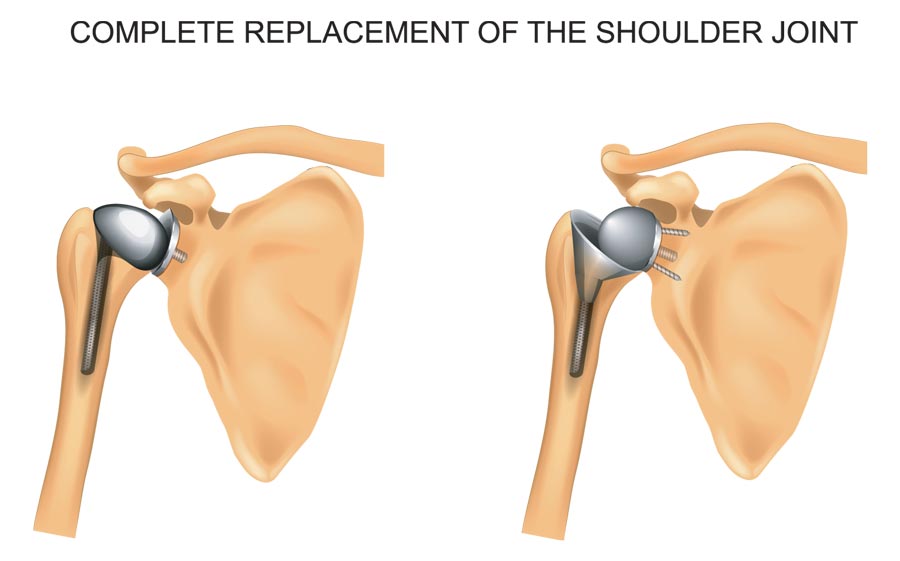
The surgical procedure may include either replacement of the head of the humerus bone (ball), or replacement of both the ball and the socket of the shoulder blade. Thus, the shoulder replacement surgeries are of three types:
- Total replacement surgery: This involves a complete replacement of the arthritic joint surface with an artificial implant.
- Hemiarthroplasty: In this type, half of the shoulder joint i.e. the humeral head is replaced with prosthesis.
- Reverse total shoulder replacement: In this type, the position of the ball and socket are switched. The metal ball implant will be attached to the natural socket, and the plastic socket is implanted on the natural humeral head.
What are the indications for shoulder replacement surgery?
Shoulder replacement surgery is recommended for patients who experience intolerable shoulder pain and instability which does not go away even with conservative treatment using anti-inflammatory medications, painkillers, or physical therapy.
The shoulder pain or instability is caused by any of the following conditions:
- Arthritis of the shoulder: It occurs when the cartilage and tendon in the shoulders deteriorate causing severe pain, stiffness and often, loss of mobility in the shoulder area. There are three basic types of arthritis that affect the shoulder.
- Osteoarthritis is a degenerative, wear and tear type of arthritis, usually occurs in people 50 years of age and older.
- Rheumatoid arthritis is an autoimmune inflammatory disorder where the body's own immune system attacks its own tissues especially joints and causes severe pain and swelling.
- Post-traumatic arthritis occurs after a serious shoulder injury causing pain and limited shoulder movements.
- Osteoarthritis is a degenerative, wear and tear type of arthritis, usually occurs in people 50 years of age and older.
- Avascular necrosis (osteonecrosis): It is a condition where the blood flow to the bone is disrupted, which causes bone cell death.
- Bone fracture: When the fractures are severe, your doctor may recommend shoulder replacement as doctor may feel difficulty in placing the broken bone pieces in place.
- Rotator cuff tear arthropathy: It is characterized with a chronic rotator cuff tear, which may lead to arthritis or destruction of joint cartilage.
What are the pre-procedure care for shoulder replacement surgery?
Once your orthopedic surgeon decides a surgical replacement for your condition, you should have some prior preparation before undergoing the surgery.
Your surgeon will schedule an appointment with a general physician for a complete physical examination several weeks before surgery. This is to ensure that underlying health conditions (if any) are managed before the surgery. In addition to this, surgeon will also enquire about the medications you are taking and based on that will advise you to temporarily discontinue or modify certain drugs as it may cause some complications during the procedure. E.g. Medicines like non-steroidal anti-inflammatory medications, anticoagulants, anti-arthritic drugs, etc. are temporarily stopped a week prior to the procedure.
Most likely, you will be admitted in the hospital on the day of surgery. You may be advised to wear loose-fitting and comfortable clothes on the day of surgery. Once admitted, you will have a discussion with the anesthesia team along with your surgeon to finalize the type of anesthesia for the surgery. The commonly used anesthesia for shoulder replacement surgery are:
- General anesthesia: When general anesthesia is administered, it will put you to sleep during the procedure and you will not have any awareness or sensations.
- Regional anesthesia: It is given to numb or prevent pain in the body. This will completely block the sensation of that area during the procedure.
How is shoulder replacement surgery performed?
Before the procedure, anesthesiologist will administer the anesthetic drug and the team will continuously monitor your vitals throughout the procedure. You will be positioned in a sitting upright position for the procedure. The surgery is performed as follows:
- Surgeon will make an incision in the pre-planned location of the shoulder.
- Damaged parts of the joint are then cut and removed.
- Artificial implants which are carefully chosen based on the position and function are the placed in the exact anatomical area.
- While fixing the implant, surgeon will make sure that the implant is neither too loose nor too tight to ensure proper restoration and balance.
- After the procedure, surgeon will carefully close the incision using stitches and a bandage is applied as a temporary covering.
What are the post-procedure care?
The entire surgical procedure will last for two to three hours. You will be shifted to the recovery room until the effect of anesthesia wear off. The shoulder replacement surgery requires few days of hospital stay for continuous monitoring after the procedure.
Post-procedure care at hospital includes:
- You will have an X-ray imaging test to confirm whether the implant is properly positioned.
- Medicines like opioids, non-steroidal anti-inflammatory drugs (NSAIDs), and local anesthetics are prescribed for short-term pain relief and swelling after the procedure.
- Physiotherapist may recommend some mild exercises the same day after the surgery to strengthen your shoulder and improve flexibility
Before leaving hospital, shoulder will be immobilized by a sling to support and protect your joint which you must wear for two to four weeks after surgery.
Post-procedure care at home mainly focuses on the rehabilitation program which is important for a speedy recovery. Physiotherapist will recommend a home exercise program which will help you to gradually return to your daily routine.
Outlook
Shoulder replacement is a surgical procedure to relieve pain and restore the normal motion and functions of shoulder joint. Though it is a less common surgery compared to knee or hip replacement, it is highly successful in reliving the shoulder pain. The complications associated with the procedure rarely occur. Within one year after shoulder replacement surgery, around 95% of patients can return to their physical activities like swimming, doing yoga, playing tennis, golf, etc.
Sources
- Shoulder Replacement. https://www.hss.edu/condition-list_shoulder-replacement.asp. Accessed on: 17-03-2020.
- Shoulder Joint Replacement. https://orthoinfo.aaos.org/en/treatment/shoulder-joint-replacement/. Accessed on: 17-03-2020.
- Artificial Joint Replacement of the Shoulder. https://www.orthogate.org/patient-education/shoulder/artificial-joint-replacement-of-the-shoulder. Accessed on: 17-03-2020.