The knee, also known as the tibiofemoral joint, is a hinge joint where the thigh meets the lower leg and provides motion. It is one of the most frequently damaged joints. An injury, arthritis, or any inflammation in the knee can result in severe knee damage causing a progressive pain, impaired function, difficulty in walking or climbing stairs, etc. When the nonsurgical treatment methods and walking aids fail to alleviate the symptoms, orthopedist will consider a surgical treatment method called knee replacement surgery to relieve pain and help you resume normal activities.
What is knee replacement surgery?
Knee replacement surgery is the procedure to replace the damaged or diseased weight-bearing bones and cartilages of the knee joint with artificial materials or implants. These implants are made up of long lasting metals, plastic or ceramic materials which will mimic the movement and function of a healthy human knee.
There are mainly two types of knee replacement surgeries:
- Total knee replacement – where both sides of your knee joint are replaced.
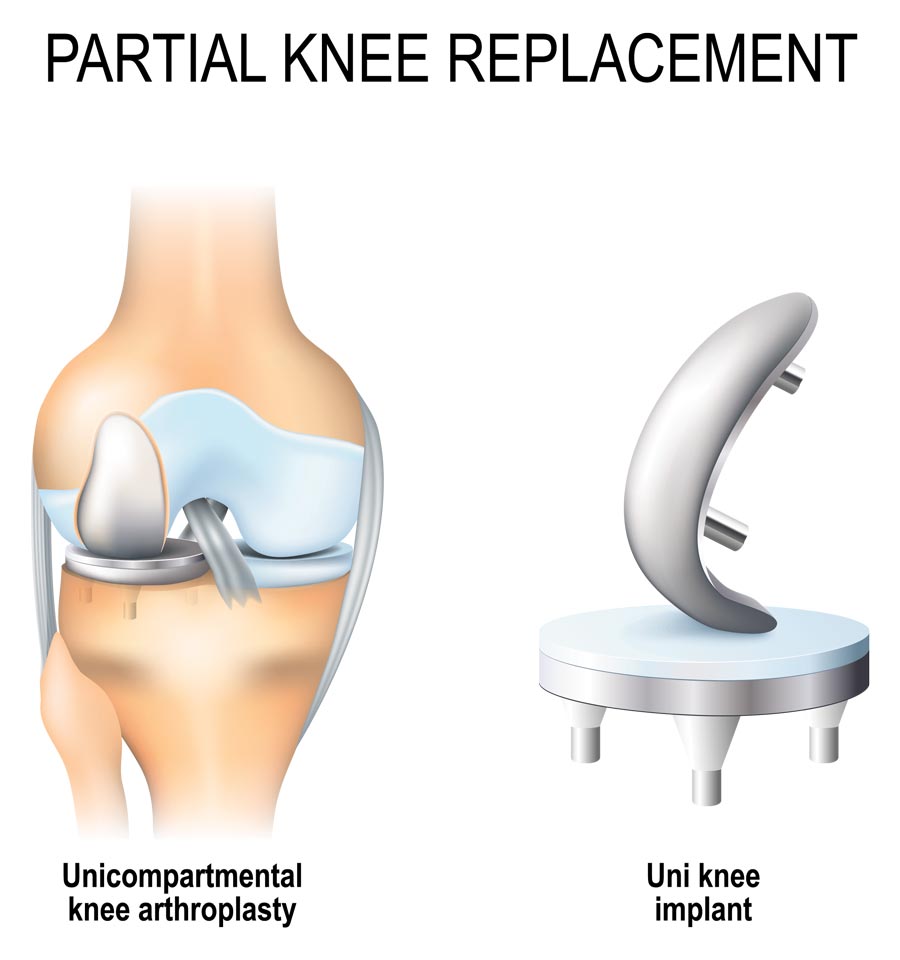
- Partial knee replacement – where only one side of your joint is replaced.
Why is knee replacement surgery recommended?
A surgical replacement of knee is recommended for patients whose knee joints have been damaged by progressive arthritis, especially osteoarthritis, trauma or other rare destructive diseases of the joint.
People who need knee replacement surgery usually have:
- Severe pain, swelling and stiffness in the knee joint that limits your everyday activities.
- Difficulty in walking and taking care of themselves.
- Knee deformity (the knees may turn outward or inward)
- Symptoms that do not improve with conservative nonsurgical treatments.
What are the pre-procedure care for knee replacement surgery?
Your orthopedic surgeon will carry out certain tests like physical examination, imaging tests like X-rays, MRI scan, etc. to confirm whether knee replacement surgery is the best method to improve the condition. Once the surgeon decides to perform a knee replacement surgery, you have to follow certain instructions to avoid risks and complications during the procedure and recovery.
Few weeks prior to surgery:
- A complete medical checkup is recommended to assess your overall health. Routine blood and urine tests are carried out for signs of infections. Chest X-rays and EKG studies are also carried out to check for any significant heart and lung disorders. If you have diabetes, heart disease, or other medical conditions, surgery will be conducted only when these conditions are controlled.
- You may have to temporarily discontinue or modify some medications which may interfere with the procedure and recovery, which may include aspirin, warfarin, ibuprofen and methotrexate.
- Obese patient (greater than 200 pounds), should maintain a healthy weight before the procedure to avoid excess stress on the knee joint during recovery.
- Your healthcare team may ask you to donate blood before the surgery for blood transfusions during the knee replacement surgery (if needed).
- You should avoid drinking and smoking, as they will slow down wound and bone healing.
- You will be referred to a physiotherapist, who will help you strengthen the muscles and increase the flexibility of the joint by some conditioning exercises.
- As you need extensive care and support after the surgery, your healthcare team will recommend you to arrange someone to assist you at home.
A day prior to surgery:
- You will be asked not to drink or eat anything for 6 to 12 hours before the procedure.
- The anesthesia team will evaluate you to finalize the type of anesthesia that is best for you. The procedure is generally carried out either by general anesthesia (it puts you to sleep) or spinal anesthesia (it numbs your body from the waist down).
How is knee replacement surgery performed?
A total knee replacement generally requires between one and a half to three hours. Before the surgery, you will be moved to the operation room and will be placed in a bent position in order to expose the joint. Once you are in position, anesthesia will be administered by the anesthesiologist.
Surgeon will make a deep incision (6-10 inch) and the kneecap is moved aside. The damaged joint surfaces are cut and removed. The artificial implant is then shaped accordingly and is fitted well in the right position. The artificial implant contains a curved metal piece that replaces the end of thigh bone, a flat metal plate that replaces the shin bone, and a plastic space between these metal pieces which acts as a cartilage.
Once the implants are properly fitted in the right position, the incision is closed with either stitches or clips and the injury is dressed.
What are the post-operative care?
After the surgery, patients are shifted to the recovery room until the effect of anesthesia wears off. The team will continuously monitor the vitals. An X-ray image is taken after the surgery to confirm the position of the implant. The post-procedure care at hospital may be as follows:
- Medicines: Medicines are prescribed for short-term pain relief and to prevent the risk of formation of blood clots.
- Physical therapy: Physiotherapist will teach exercises to strengthen the muscles and restore the knee movements. The patient should begin moving the new knee joint 48 hours after the surgery.
- Supportive devices: A knee support called continuous passive motion (CPM) exercise machine is used to move the knee through various angles and restore the range of motion for hours while the patient relaxes.
A catheter may also be inserted into the urethra in patients who have trouble in passage of urine after the surgery.
After the surgery, you will be discharged in a couple of days. Before being discharged from the hospital, your surgeon will give some measures to be followed at home for a speedy recovery:
- Use cane, crutches, or a walker for the first few weeks after surgery, until your balance, flexibility, and strength has improved.
- Keep your bandages and surgical dressings clean and dry to avoid infections.
- Follow a balanced diet rich in iron which aids in faster wound healing and in restoring muscle strength.
- Exercise regularly, as instructed by your physical therapist.
Most people can stop using walking aids around 6 weeks after surgery and return back to normal activities after 6-8 weeks post-surgery.
Outlook
Knee replacement surgery provides an excellent result in relieving the pain, restoring the normal knee movements and improving quality of life. Most patients can return to normal activities after recovering from knee replacement surgery.
Physical-therapy program along with home exercises should be continued during the recovery period. The recovery time varies from person to person.
Most artificial knee joints last for 10 to 15 years. A follow-up is necessary once a year to evaluate the functioning of the device. If you undergo knee replacement surgery at a young age, you may need a second surgery to replace the deteriorated implant.
Sources
- Total knee replacement. https://orthoinfo.aaos.org/en/treatment/total-knee-replacement/. Accessed on: 12-03-2020.
- Knee replacement. https://www.mayoclinic.org/tests-procedures/knee-replacement/about/pac-20385276. Accessed on: 12-03-2020.
- Knee replacement. https://www.nhs.uk/conditions/knee-replacement/. Accessed on: 12-03-2020.
- Knee joint replacement. https://medlineplus.gov/ency/article/002974.htm. Accessed on: 12-03-2020.