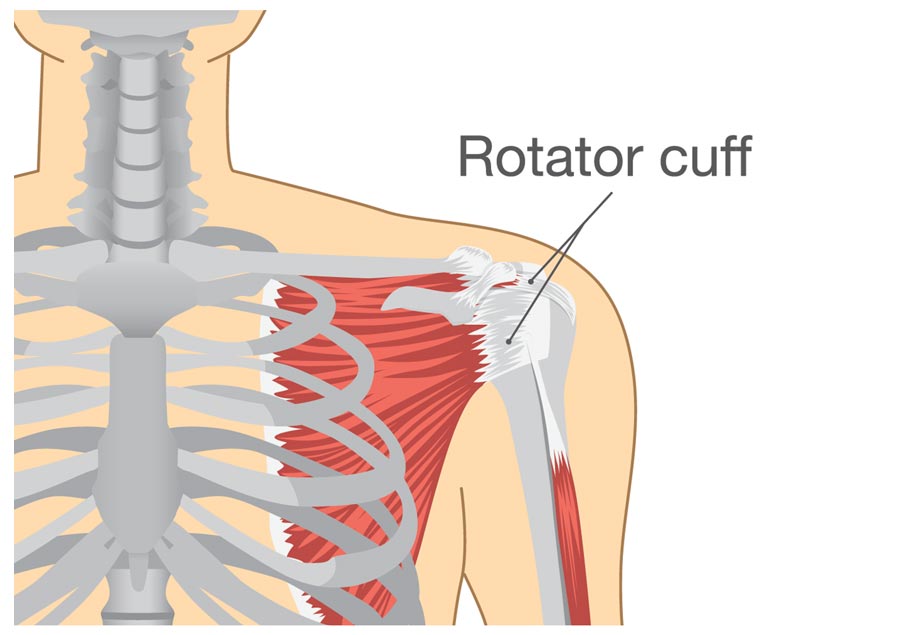
Have you ever thought, what kind of arrangement makes our arms to perform so many diverse movements? In simpler terms, it could be best explained as a ball moving in a socket and a rotator cuff is one which holds this arrangement.
The rotator cuff consists of a group of muscles and tendons that help in keeping the ball of your upper-arm bone securely in your shoulder blade socket. It aids in lifting or rotating your arm. Rotator cuff refers to the tendons that help in the movement or rotation of the arm head within the socket.
Any injury to the rotator cuff is often associated with mild ache in your shoulder, which may increase when you try to sleep on your affected joint.
What are the symptoms of rotator cuff injury?
The common symptom of the rotator cuff injury is pain in your shoulder and upper arm. Often people may experience dull pain deep in the shoulder. The pain is more apparent when you lift your arm while turning it at the same time. Examples of this kind of motion include combing your hair or trying to reach behind your back. You may also have mild pain during sleep that may disturb your sleep, especially when you lie on the affected shoulder.
Other signs and symptoms may include:
- Locking in the shoulder joint
- Restricted movement
- Instability in your shoulder
When the rotator cuff injury involves significant damage to your tendons, it may cause arm weakness. This affects your ability to lift an object or to hold your arm.
What causes rotator cuff injuries?
When you lift your arm or turn it, the tendons present in the rotator cuff have to move within a tight space, making them more prone to injury. Any repetitive activity for a prolonged duration may irritate or damage your tendons. Sometimes, your tendons may also rub against the bony knob (acromion) leading to inflammation in the rotator cuff. The inflammation may lead to the following conditions.
- When the inflammation is confined to a single tendon, it may cause pain during specific movements. This condition is known as rotator cuff tendonitis.
- When the inflammation spreads into the pocket of fluid that helps in lubricating the rotator cuff tendons, you may feel pain when you move your shoulder in any direction and it may get worse at night. The condition is called as shoulder bursitis or subacromial bursitis.
- Prolonged inflammation may lead to weakening of tendons that may result in tears in the rotator cuff.
Other possible factors that may increase the risk of shoulder injury include:
- Repetitive activities that may damage the tendon tissue
- Pushing off using your arms while getting up from a chair
- Sudden jerking movements while trying to lift something heavy
- Keeping the arm in same position for longer period, such as while using computers
- Forceful overhead arm movements in sports like weight lifting, baseball, tennis or archery
- Occupations involving repetitive overhead arm movements such as construction, painting or carpentry
- Ageing and deterioration of cuff
How is the rotator cuff injury diagnosed?
Rotator cuff injury is usually diagnosed through physical exam. During a physical examination the physician may try to rotate your arm at the shoulder and lift your arm. These kinds of movements are usually painful when your rotator cuff is inflamed. Your physician may also try to rule out if the pain is coming from other body parts such as neck or heart. If you have noticeable weakness or when the doctor suspects tears in the cuff, further testing may be recommended such as:
Magnetic Resonance Imaging (MRI): MRI is the most common imaging technique used in the diagnosis of rotator cuff injuries. It is helpful in identifying the inflammation or tears present in the tissues. MRI scans are also useful in determining the size, location and characteristics of the tears.
Ultrasound: Ultrasound is helpful in studying the soft tissues in the body, such as your muscle and tendons. It is useful in analyzing the structures of your shoulders while you move your shoulder.
X-rays: X-rays are recommended when there is a trauma to your shoulder. They are also useful to identify whether the pain is due to calcium deposits around tendons, arthritis or other problems that may lead to rotator cuff tears.
What are the treatment options for rotator cuff injuries?
Many treatment options are available for rotator cuff injuries. However, conservative treatment is the first line option unless the condition is severe. The goal of the treatment is to reduce pain and restore functionality.
The common treatment options include:
Rest: Give adequate rest to the affected arm by avoiding activities that can cause further damage to tissues.
Ice: Applying ice packs for 20 minutes three to four times a day, may help in reducing pain and inflammation.
Altering activities: Learning how to use your shoulder in a safe and comfortable manner proves beneficial in avoiding further damage.
Physical therapy: Physical therapy helps in restoring the flexibility and strength of your shoulder. Your physician may suggest exercises depending on your condition that helps in accelerating your recovery process.
Medications: Medicines, such as ibuprofen is helpful in managing symptoms like pain and inflammation. The physician may administer corticosteroid injections directly into the shoulder, if the pain is interfering with your regular activities and sleep.
Surgery: If the above treatment options fail to provide relief even after using them for extensive period or when the injury is recent, recurring or acute, surgical treatment is considered. Many surgical options are available for repairing rotator cuff injuries, and the right procedure is opted depending on the damage happened, individual health and personal goals.
How can one prevent rotator cuff injury?
Prevention of rotator cuff injury is always possible through avoiding repeated over head movements. It is also important to avoid using your arms to push yourself from a chair. Practice certain exercises that strengthen your rotator cuff muscles. Additionally, these exercises prevent future injuries. However, consult a physical therapist to plan a daily exercise routine to strengthen the rotator cuff muscles around your shoulder.
References
- https://www.mayoclinic.org/diseases-conditions/rotator-cuff-injury/symptoms-causes/syc-20350225
- https://www.health.harvard.edu/a_to_z/rotator-cuff-injury-a-to-z
- https://orthoinfo.aaos.org/en/diseases--conditions/rotator-cuff-tears/
- https://handcare.assh.org/Anatomy/Details-Page/ArticleID/27957/Rotator-Cuff-Injuries
- https://www.umms.org/ummc/health-services/orthopedics/services/shoulder-elbow/shoulder-conditions/rotator-cuff-injury-or-tear