Our skeletal system is made up of 206 bones that are connected to each other providing a basic framework, posture, movement and weight-bearing. Despite their hardness and strength, bones are susceptible to a wide variety of injuries.
Although most of the bone injuries are obvious on routine physical examination and tests like X-rays, CT scan etc., sometimes the orthopedic surgeon may need to look inside the joint to diagnose a joint condition.
What is diagnostic arthroscopy?
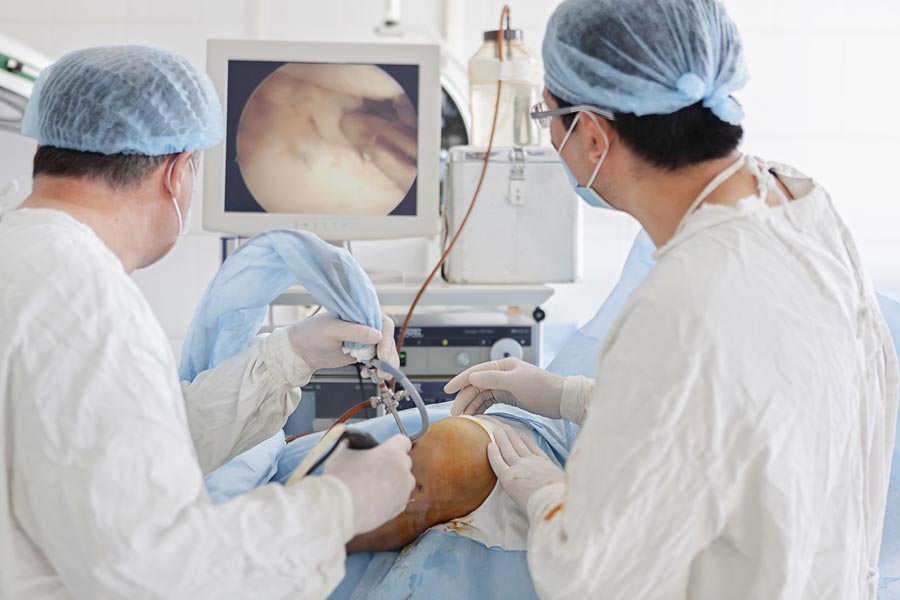
An arthroscopy is a minimally-invasive procedure performed using a scope with a mounted tiny camera and with specialized instruments. Unlike open surgeries, the procedure involves small incisions that heal faster and better. The arthroscopy helps to visualize, diagnose, and treat various problems related to bone and joint conditions. A diagnostic arthroscopy is used to view inside the injured joints and to check for disease or damage inside it.
Indications for diagnostic arthroscopy
The procedure is most commonly used for diagnosing injuries affecting joints like knees, ankles, shoulders, elbows, wrists and hips.
Some of the most frequent conditions that are diagnosed by arthroscopic examinations of joints are:
- Synovitis: An inflammation of the cartilage lining in the knee, shoulder, elbow, wrist, or ankle.
- Acute or chronic injury of ligaments in shoulder, knee, wrist and cartilage.
- Pieces of torn cartilage that are loose in the joint
- Some limited use in arthritis conditions.
Diagnostic arthroscopy is also recommended along with other surgical procedures like rotator cuff surgery, release of carpal tunnel syndrome, etc. to view and assess the level of damage.
What are the pre-procedure care for diagnostic arthroscopy?
Before having an arthroscopy, your general health will be assessed. Your physician will enquire about your medical history, lifestyle habits and may recommend some changes depending on which of your joints is affected. In general, your healthcare team may recommend:
- To not eat or drink anything after midnight on the day of your procedure.
- To stop taking certain medicines that may increase your risk for bleeding, like aspirin.
- To arrange for loose and comfortable clothing to wear after the procedure and also to make arrangements to have someone to drive you home.
How diagnostic arthroscopy is performed?
Though each procedure will vary, generally, diagnostic arthroscopy follows this process:
- You'll be placed in the best position for the procedure to enhance the visibility inside the joint. You may be asked to lie on your back or on your side.
- The procedure is usually carried out under anesthesia. A member of the anesthesia team will discuss with you before the surgery to finalize the choice of anesthesia; the types of anesthesia used are:
- Local anesthesia: which numbs a limited area, such as only your knee joint, or hip joint etc.
- Regional anesthesia: which blocks the sensation in the bottom half of your body (below waist) but you remain awake.
- General anesthesia: which keeps you unconscious throughout the procedure.
- A small incision is made on the affected joint, and the arthroscope is inserted. A sterile solution is injected to expand the area around the joint and to get clear images through the inserted camera.
- The view of the arthroscope is transmitted to an external monitor.
- A corrective surgery, (if needed) may be done during the initial diagnostic procedure by making additional incisions through which the specialized instruments are inserted.
- After the procedure, the instruments are removed, and the incisions will be covered with a dressing or bandage.
What is the post-procedure care?
Diagnostic arthroscopy is carried out on an outpatient basis where you can return to your home on the same day the surgical procedure is performed. The procedure usually doesn't take long and you will be moved to the recovery room soon after the procedure. Before being discharged, you will be given a set of instructions to follow for a speedy recovery, along with follow-up visit schedule.
Post procedure care may include:
- Medications: Medication may be prescribed for relieving pain and inflammation. In some cases, anti-coagulant drugs like aspirin is prescribed to prevent the risk of blood clots.
- R.I.C.E therapy: Your doctor may recommend R.I.C.E. therapy to reduce pain, swelling and a speedy recovery. The therapy includes:
- Rest: Stay away from activities that cause pain. A complete rest to the area will speed up the recovery.
- Ice: Apply an ice or cold pack on the sore area to prevent or minimize swelling. Make sure that you are not applying ice pack directly to the skin.
- Compression: Wrap the area with an elastic bandage to decrease swelling and pain. It also acts as a support and will reduce the strain in that area.
- Elevation: Keep the area above heart level to reduce the swelling, as the fluids will move away from the injured area.
- Dressing care: It is important to keep the incision dressing clean and dry. You may be advised to place a cover or bag over the dressing while showering.
- Exercises: To restore motion and strengthen joints, your doctor will prescribe physical therapy and rehabilitation.
One can usually resume their normal activities within a week after the surgery. However, the recovery time varies with the procedure and post procedure care.
Outlook
Arthroscopy is basically a simple diagnostic tool to visualize and identify the joint injuries. The procedure is also used to treat certain knee conditions like meniscal tears, removal of synovial tissue, treating knee infection, etc., and the recovery time also varies accordingly. Most cases one can return to work or other activities within a few days of procedure, but full recovery may take several months. Follow your surgeon's guidelines and rehabilitation plan for a successful outcome of the arthroscopic procedure.
Source:
- Arthroscopy. https://www.mayoclinic.org/tests-procedures/arthroscopy/about/pac-20392974. Accessed on: 28-02-2020.
- Arthroscopy. https://orthoinfo.aaos.org/en/treatment/arthroscopy/. Accessed on: 28-02-2020.
- Arthroscopy. https://www.hopkinsmedicine.org/health/conditions-and-diseases/arthroscopy. Accessed on: 28-02-2020.
- Arthroscopy. https://www.nhs.uk/conditions/arthroscopy/. Accessed on: 28-02-2020.