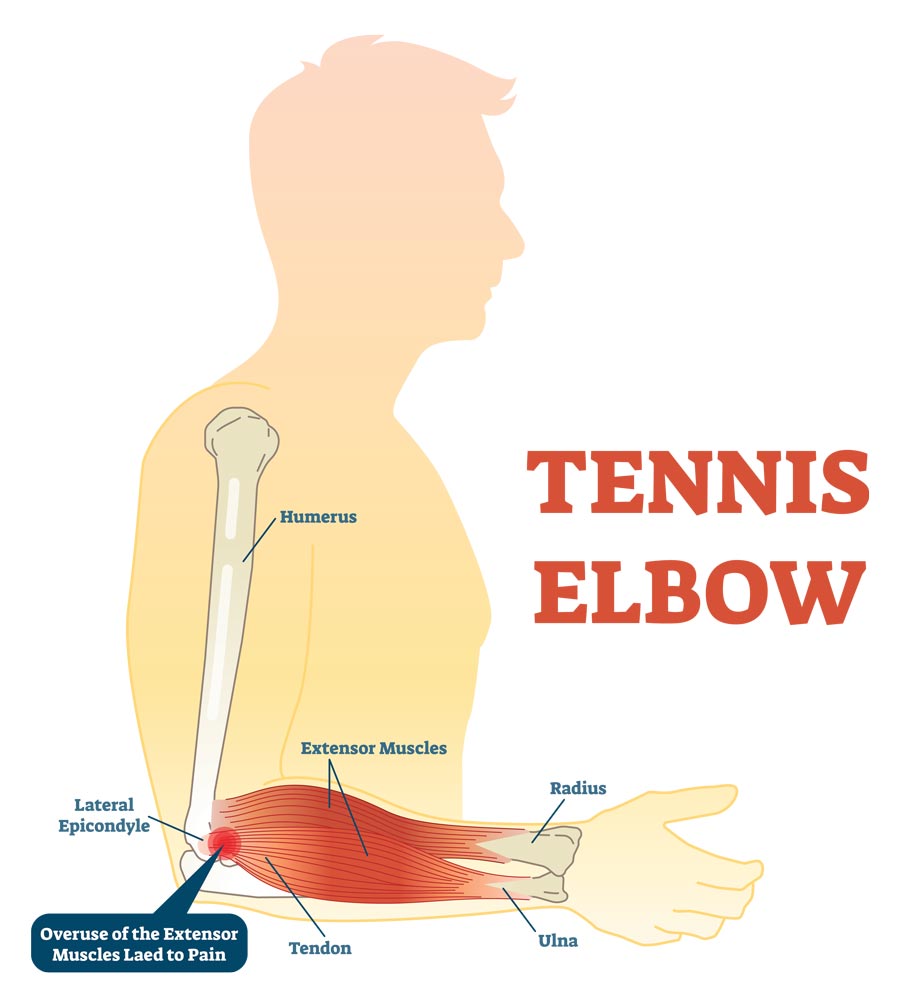
The elbow is a stable joint connecting your humerus (upper arm bone) with radius and ulna (forearm bones). The muscles, tendons and ligaments present around the elbow helps in holding the elbow joint together. Tennis elbow is a painful condition of the elbow due to inflammation of the tendons joining the forearm muscles on the outside of the elbow (i.e. lateral epicondyle of the humerus). Hence, it is also known as Lateral epicondylitis.
By the name it is well understood that tennis elbow is a common condition in people engaging in sport activities like tennis. However, overexertion of the hand, repeating the same motions again and again or any sudden unusual activity may equally contribute for developing the condition. The tendon that is commonly involved in the tennis elbow is known as the Extensor Carpi Radialis Brevis (ECRB).
What are the symptoms of Tennis Elbow?
The most common symptom of the tennis elbow is pain that is felt on the outside of the elbow. It is usually mild initially and progresses gradually. Over time, it may turn into a constant pain making it painful to touch the elbow or difficult to stretch it fully.
You may experience increased pain and feel difficulty in:
- Lifting or bending your arm
- Twisting forearm for turning a door knob
- Gripping an object
- Using tools or opening jars
- Shaking hands
- Squeezing
What are the causes of Tennis Elbow?
The increased risk for the damage to the ECRB muscle is related to its position. Overuse or repeated bending or straightening of our elbow may cause tiny tears near the origin of the ECRB at the lateral epicondyle leading to inflammation and pain.
The activities involving in repetitive movements of the wrist and arm hat may increase the risk for the condition include
- Tennis or other racquet sports like racquetball or squash
- Golfing
- Cooking
- Swimming
- Painting
- Plumbing
- Carpentering
Tennis elbow is more common in people aged between 30-50 years. Poor stroke techniques or the use of improper equipment during the racket sports may also increase the risk for the condition.
How is Tennis Elbow diagnosed?
The diagnosis involves in reviewing the comprehensive medical history. Details like when and how the pain was started and conditions that aggravate pain are assessed. During examining your elbow, the physician may ask you to straighten your fingers and wrist against resistancewith your elbow extended. The development of pain during such tests reveals that the muscles involved are not in a healthy condition.
Other tests may be used to know if there are other conditions that may cause the symptoms. They include:
X-rays: The clear images of the bones obtained by X-rays helps to rule out arthritis of the elbow.
Electromyography (EMG): This test helps to identify if there is any problem in the nerves present around the elbow, which may cause symptoms similar to that of tennis elbow.
Magnetic resonance imaging (MRI): This test provides details about the extent of damage in the soft tissues or tendons around the elbow. It also helps to rule out other problems such as arthritis in your neck or disk problems in your spine, which may often lead to arm pain.
How is the condition treated?
In majority of cases, tennis elbow can be treated by following simple home remedies, sexercises and therapies. If the pain still persists after following extensive physical therapies, other procedures such as surgery may be recommended.
The general treatment line followed for tennis elbow includes:
Rest: Providing ample rest for your arm remains as the first step for better recovery. It is important to stop participating in activities that can aggravate and worsen your condition.
Occupational Therapy: It includes recommending corrective movements or techniques for your jobs or tasks to be performed on the daily basis.
Physical therapy: Physical therapy includes exercises involved in stretching and improving muscle (forearm) strength are also recommended.
Brace or sling: Using forearm strap or brace after consulting your physician may also helps to reduce stress on the injured tissues.
Medications: Certain medications such as Non-steroidal anti-inflammatory drugs (aspirin, ibuprofen) may help in reducing pain and swelling.
Injections: Injections such as steroids (cortisone), Botox (botulinum toxin type A) may be injected into the painful tendon to help relieve your symptoms.
Ultrasonic tenotomy: This is an ultrasound guided procedure during which a special needle is inserted into the damaged tissue. The needle vibrates quickly to pierce the damaged tissue and suctions out the liquefied (treated) tissue.
Surgery: If there is no improvement in the condition even after following all the above non-surgical treatments for about six months, surgery may be recommended. It usually performed through large incisions or through several small incisions to remove the damaged muscle and reattaching the healthy muscle to the bone. Both the surgeries are outpatient procedures and the selection of which is based on the scope of injury, general health and personal factors. Rehabilitation process is important after the surgery that may involve in immobilizing your arm temporarily using a splint followed by stretching exercises that help to restore flexibility of your elbow.
How to prevent tennis elbow?
Prevention of the condition might not be always possible. However, increasing the strength of your forearm muscles can help to prevent tennis elbow. Taking a physiotherapist’s advice to know how to build your forearm muscles with the help of some exercises and how to keep your arms flexible and strong might be helpful. It is also important to avoid repetitive movements. If you are involved in sports or other repetitive activities, warming up before starting them is beneficial. It is also important to ensure that the equipment you are using is right for you.
References
- https://www.mayoclinic.org/diseases-conditions/tennis-elbow/diagnosis-treatment/drc-20351991
- https://orthoinfo.aaos.org/en/diseases--conditions/tennis-elbow-lateral-epicondylitis/
- https://www.hopkinsmedicine.org/health/conditions-and-diseases/lateral-epicondylitis-tennis-elbow