What is ankle fusion?
Ankle fusion or ankle arthrodesis is a surgical procedure done to fuse the bones of the ankle into one solid bone. The ankle joint is formed by the lower end of the shinbone (tibia) and top of a bone of the foot known as talus. This joint acts as a hinge and allows the foot to move up and down.
Why is ankle fusion performed?
The main purpose of ankle fusion surgery is to treat arthritis in the ankle which does not get relieved with other non-surgical methods. The 3 main types of ankle arthritis are:
- Osteoarthritis that results from the wear and tear of the cartilage
- Rheumatoid arthritis that occurs when the immune system attacks one’s own body cells
- Arthritis due to a traumatic injury to the joint
- Rarely in fractures of the ankle and foot, are which deemed to be irreparable.
This surgery is also recommended in patients with severe deformity or an unstable ankle for various reasons.
If the above conditions lead to severe symptoms interfering with the daily activities, then ankle fusion surgery may be recommended. Ankle fusion helps in a long-lasting pain relief but limits the ankle’s mobility.
Preparation for the surgery
Preparing for the surgery helps the patient in staying calm and in-control during the surgery. The following preparation is necessary:
- Inform the doctor in advance about the medicines currently in use. This is because the doctor might ask the patient to stop taking certain medicines for a few days before and after the surgery.
- Do not eat or drink for a few hours before the operation.
- Avoid smoking for some days as suggested by the doctor to help in fast healing after the surgery.
- Arrange for transport to get back home after the surgery.
- Arrange for someone at home to help with daily activities after discharge as it may not be possible to walk without support for some weeks after the surgery.
Before the surgery, the doctor may need imaging tests such as CT scans, X-rays or ultrasound or a magnetic resonance imaging (MRI) scan.
Procedure of ankle fusion surgery
Ankle fusion surgery is performed by an orthopaedic surgeon assisted by a team of specialised healthcare professionals.
The patient is given spinal anaesthesia or general anesthesia to prevent painful sensation during the operation.
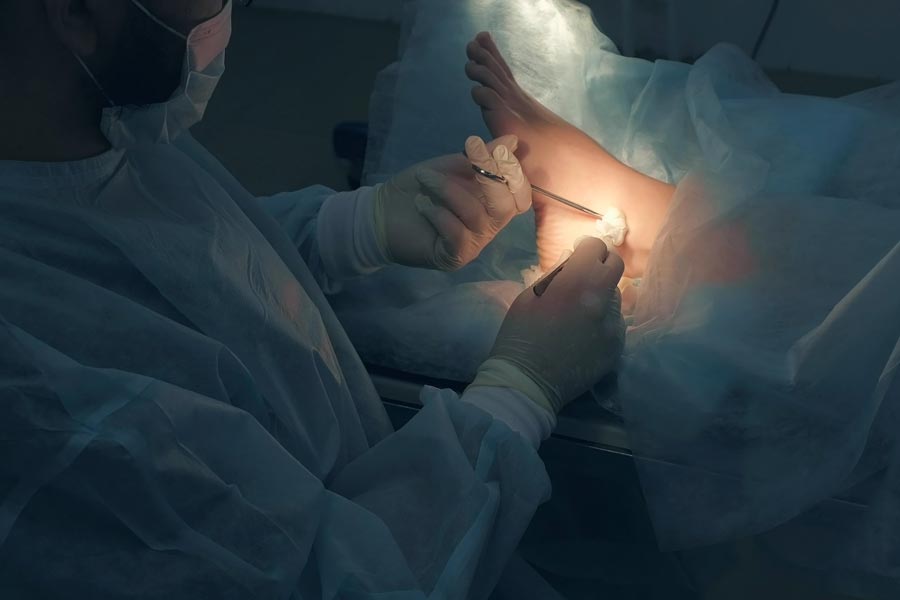
An incision is made to cut open the skin and muscle of the ankle. Through this incision, a small camera with light (known as arthrooscope) is inserted into the joint. The surgeon removes the damaged cartilage from the affected joint (this can be done by a formal open procedure also) and connects the bones together while aligning them in proper position using necessary hardware, usually an ankle fusion nail, there are other methods to achieve compression of the bony surfaces together. In case there is an infection prior, implant use is contraindicated and an external fixator with POP may be used to achieve ankle fusion. Finally, the incision is closed with stitches or staples.
The vital signs such as heart rate and blood pressure are regularly monitored during the surgery.
Recovery from the surgery
The patient may have to stay for 2 to 3 days in the hospital after the surgery. The time for recovery depends on the general health of the individual and the type of surgery.
Pain medicines are given to relieve the pain associated with the surgery. After the surgery, the operated leg is kept elevated to reduce swelling. Once the swelling reduces and the incisions heal, a plaster cast is applied from knee to the toes. This helps in proper fusion of the ankle and the cast may be worn for 3 to 4 months. Do not put weight on the foot as it can delay the healing.
Instructions would be provided to the patient regarding the use of crutches without putting weight on the foot and about how to move the foot.
X-rays may be taken regularly to monitor the healing of the fused joint. Once the joint has fused as confirmed from the x-rays, the cast is removed and a brace is applied to provide support during weight-bearing. The brace may be worn for a month.
What are the risks associated with ankle surgery?
Similar to the other surgical procedures, ankle fusion is associated with certain risks. Sometimes one or more of the following complications can occur in the patients:
- New arthritis in the nearby joints
- Bleeding and blood clots
- Swelling
- Stiffness
- Infection
- Nerve damage and numbness around the incision
- Improper joining of the bones
- Misalignment of the bones
The complications can vary with individuals depending on their overall health. For example, people with diabetes, low bone density and habits such as smoking are at a higher risk of developing certain complications.