Our ankle is a hinge joint that permits movement and allows us to walk, jump, run and do other activities. Several strong bands of connective tissues called ligaments hold the bones of the ankle in correct alignment supported by the attached muscles. Injuries to the foot and ankle are one of the frequently occurring musculoskeletal injuries and are likely to happen in athletes either as an acute injury or part of repetitive trauma on their ankles.
When the tendons are torn, they may do not provide stability and support to the ankle joint, leading to swelling, intense pain and joint instability. When the torn ligaments are left untreated, it may lead to instability and pain. When there is pain and instability, to prevent delayed complications, these ankle ligaments must be repaired.
What is ankle ligament repair?
Ligament repair refers to the surgical repair of injured or torn ligaments to restore the normal function of joints and supporting structures of the foot.
For the symptomatic relief of ankle ligament tear, appropriate nonsurgical treatments like RICE protocol and physical therapy are recommended. A surgical repair is recommended only when the conservative treatment fails to relive instability, pain and other associated symptoms.
The types of ligament repair surgeries include:
- Direct primary repair which involves suture or stitches to repair the torn ends to each other.
- Secondary repair which involves a graft or tendon transfer to substitute the torn ligament..
A ligament tear can be either a complete rupture into two separate detached pieces or partial rupture. They can be acute (fresh injuries) or chronic (old injuries)
Why is an ankle ligament repair recommended?
Most people with ligament tear won’t need surgical repair. The surgical repair is recommended based on some factors like:
- Instability Pain
- No response to non operative treatment
What are the pre-procedure care for ankle ligament repair?
Once your surgeon decides that surgical repair is required to treat your ligament tear, it is important to plan and prepare yourself for the surgery to ensure a healthy recovery. Before the surgery, a complete physical checkup is performed to assess overall health, other medical conditions and medicines being taken. He/she will also recommend some laboratory tests like blood and urine tests and imaging tests like X-rays, electrocardiogram. You will be asked to quit smoking as it may delay the healing time. You will be asked to temporarily stop taking some medications like aspirin, ibuprofen, and blood thinners as it may cause some complications during the procedure. Surgeon will also suggest maintaining a healthy weight before the surgery by following diet and exercises.
In addition to the above, the healthcare team will give you certain instructions for the day prior to the surgery. This includes:
- Do not eat or drink anything few hours before your surgery as it may interfere with the anesthesia administered.
- Arrange loose fitting clothes that will fit comfortably over your leg cast or splint that you wear after the surgery.
- Arrange someone to drive you home when you are discharged.
Before the procedure, you will have a discussion with the anesthesia team to finalize the type of anesthesia. The anesthesia type depends on the medical history of the person and the procedure. The possible types of anesthesia for tendon repair are:
- General anesthesia: Patient will remain unconscious throughout the procedure.
- Regional anesthesia: It will numb a large area around the surgical site, like the bottom half of your body (below waist) but you will remain awake.
- Local anesthesia: This will numb only the area that needs surgery. The patient remains awake but will not feel any pain during the procedure.
How is ankle foot tendon repair performed?
You will be initially taken to a pre-operative area, where an anesthesiologist administers anesthesia intravenously, and then will be shifted to the operating area. The surgery is performed as follows:
- Surgeon will make a cut through the skin over the injured ligament tendon and examine the extent of damage.
- If the tear is acute then the tendon tissue will be repaired by sewing them together with sutures.
- If the tendon tear is chronic, the tear is repaired augmenting with a graft or the damaged portion is surgically removed and the remaining portion is sutured to the nearby tendon.
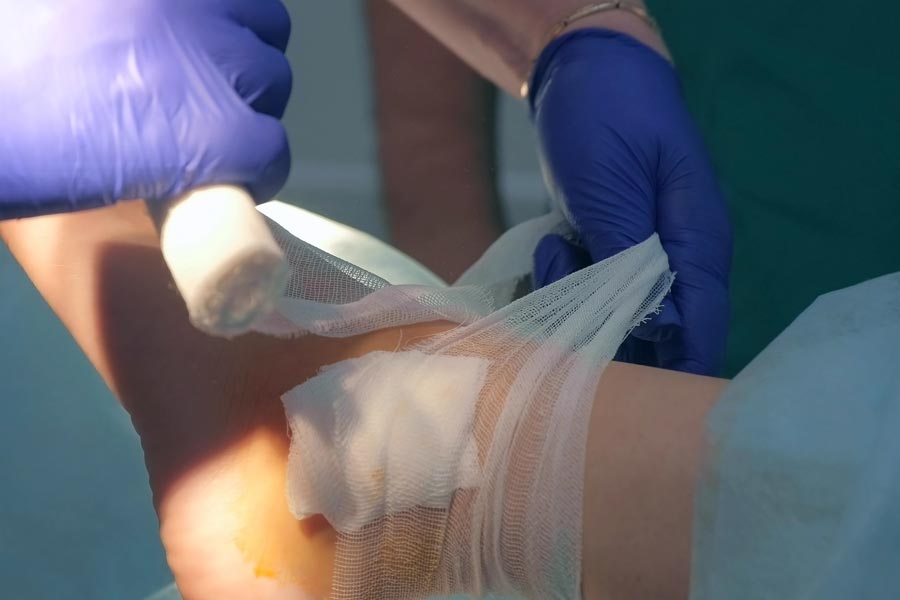
- Once the procedure is complete, surgeon will sew the cut skin back together with stitches and cover with surgical dressings.
What are the post-operative care?
After the procedure, you will be under observation in the recovery room until the effect of anesthesia wears off. In most cases, you can go home the same day after the surgery, but the hospital stay may differ based on the procedure. The post-operative care at hospital includes:
- Surgeon will prescribe medications like opioids, non-steroidal anti-inflammatory drugs (NSAIDs), and local anesthetics for the short-term pain relief.
- A physiotherapist will guide you with the correct exercises to strengthen the muscles and to restore the ankle movements.
- You will be on crutches for about six weeks after the surgery to avoid putting weight on the ankle as there are chances for further damage of the tendon.
Before being discharged from the hospital, you will be given instructions for rehabilitation at home, which includes:
- Keep the bandages clean and dry to avoid chances of infection.
- Give proper rest and to keep your leg in an elevated position to avoid swelling in the operated area.
- Follow the instructions of your physiotherapist and do exercises for the affected joint.
You can return to your normal activities as instructed by your surgeon. The duration of the recovery time depends on the procedure, type of anesthesia, your health, age, and other factors.
Outlook:
Ligament repair surgeries will improve foot and ankle function and help you to lead an active, normal life. Though the procedure has some minor risks, the surgery can be successful by following the instructions of the physiotherapist and surgeon. One can usually return to their regular activities, even sports within six months after the procedure. Maintaining a healthy body weight and some lifestyle modifications will improve the outcome of the procedure.
Source:
- Peroneal tendon injuries. https://www.foothealthfacts.org/conditions/peroneal-tendon-injuries. Accessed on: 23-03-2020.
- Tendon repair. https://www.surgeryencyclopedia.com/St-Wr/Tendon-Repair.html. Accessed on: 23-03-2020.
- Foot and ankle surgery. https://www.versusarthritis.org/about-arthritis/treatments/surgery/foot-and-ankle-surgery/. Accessed on: 23-03-2020.
- Foot tendon tears. https://intermountainhealthcare.org/services/orthopedics/services/foot-and-ankle/foot-tendon-tears/. Accessed on: 23-03-2020.
- Achilles Tendon Repair Surgery. https://www.hopkinsmedicine.org/health/treatment-tests-and-therapies/achilles-tendon-repair-surgery. Accessed on: 23-03-2020.