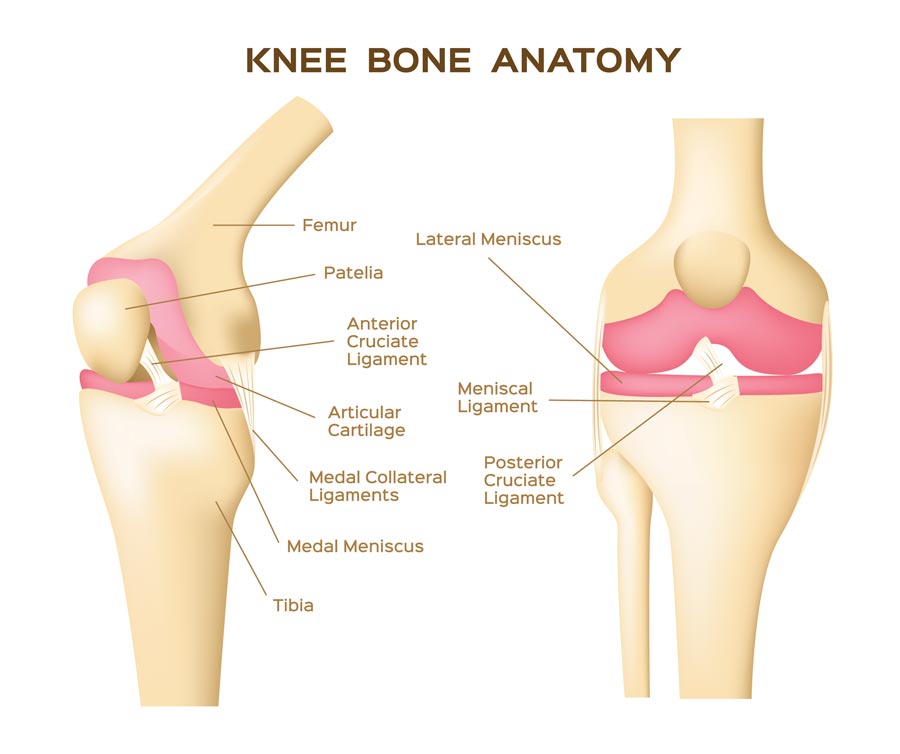
There are four major ligaments located within the knee. One of these joins the intercondylar region of the tibia to the medial condyle of the femur from behind. This ligament is known as the posterior cruciate ligament. The PCL is considered to be stronger and larger than the anterior cruciate ligament (ACL). PCL injuries comprise 20% of the total injuries occurring to knee ligaments.
Causes of PCL
Quite often, a PCL injury may damage other ligaments and cartilage of the knee. There are also reports of cases, where a ligament may cause a bone to come off. Some of the causative factors of PCL are given below:
- A fall on the knee in the bending position.
- Hitting the knee against the dashboard in an auto accident.
- An injury occurring while playing sports like football, baseball, soccer or skiing.
Grades of PCL tear
Based on the severity PCL injury it is classified into 4 grades:
- Grade I- It is a mild injury caused by limited damage of the PCL. Although, this can change the shape of PCL, they do not affect the functioning and stability of the knee.
- Grade II- In this grade PCL is partially injured and the stability of the knee is also affected to some extent.
- Grade III- The ligament is completely torn and the knee becomes more unstable.
- Grade IV- This is the most severe form of injury where another ligament is also damaged along with the PCL.
Symptoms of PCL Injury
Most of the people consider PCL to be a minor injury and continue their daily life activities. Overtime, people with PCL injury may experience the following symptoms:
- Knee pain
- Difficulty while walking
- Instability in the knee
- Stiffness of the knee
Ways to diagnose PCL Injury
Diagnosis of PCL injury will include the following:
Background information- The doctor will review your medical history by asking few question regarding the condition of knee during the injury. Additionally, the doctor will ask you about the symptoms, existing medical conditions, current medications, and your social habits.
Physical examination- In order to know whether it’s a PCL injury, your doctor will recommend you to lie down, resting on the back, with your knees bent. This allows the doctor to press the knee and the area of the upper shin. Your doctor may ask you to walk around. Any abnormality in the knee movement during this check-up suggests a PCL injury. Another way of checking the condition is the usage of an arthrometer (a medical device to measure the joint movements). This device is held close to the leg to check the degree of abnormal mobility. .
Imaging techniques- An X-ray is recommended to check if there is any bone fracture. X-ray is not able to detect ligament injury so, a MRI is done to obtain information about the PCL tear. The images obtained help to get a clear picture as to the exact location of the injury.
Treatment of PCL Injury
PCL injuries do not require any surgical intervention, especially if it is a grade I or II injury. Some people have to undergo physical therapy as part of the treatment plan. The process may include the following:
- Using crutches while walking.
- Taking the assistance of a machine will help in free movement of the leg.
- Wearing knee braces to support the leg.
- Strengthening thigh muscles by walking or running on a treadmill.
Symptomatic PCL injuries will require reconstruction using an allograft or a graft taken from some other part of the knee, to substitute for the lack of PCL and this can be done arthroscopically.
Self-care of PCL Injury
Minor PCL injury can be effectively managed by following the PRICE approach. PRICE entails the following steps:
- Protecting the knee from further injuries.
- Resting the knee adequately.
- Icing the injured part with cold compress at regular intervals.
- Compressing the knee with an elastic bandage.
- Elevating the knee above your heart level.
Sometimes, to treat the knee pain, painkillers may be administered.