Developmental dysplasia of the hip (DDH) occurs when the babies are born with hip joints that are not properly formed. It is also called congenital hip dislocation (CHD). The normal hip has a ball-and-socket joint. The ball at the upper end of the femur fixes firmly in the socket of the large pelvis bone. Children who have this condition have the ball loosely placed in the socket, that can be easily dislocated.
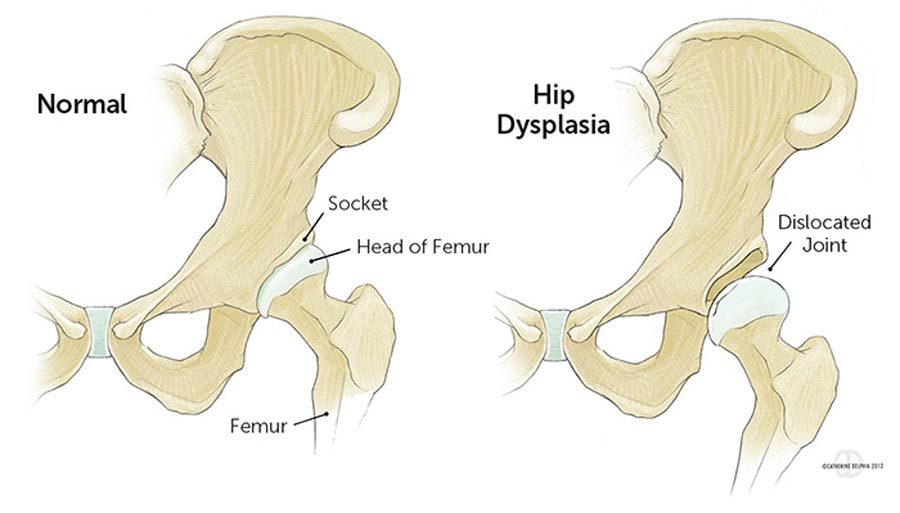
Causes and risk factors of Developmental Hip Dysplasia
Although there are no known causes for the occurrence of this condition, there are certain contributing factors. These are as given below:
- Low levels of amniotic fluid in the womb
- Breech presentation
- Family history
- Other congenital anamolies
Confinement in the uterus may cause this condition and it is more likely seen in the first pregnancy. Congenital hip dislocation is more commonly seen in girls than in boys. It can take place anytime during the first year of a child’s development.
Symptoms of Developmental Hip Dysplasia
If your child suffers from this condition, he or she may exhibit the following:
- Legs appear to turn outward or there may be a difference in their length.
- Appearance of folds on buttocks which are uneven on extending the legs.
- Limited range of motion.
- Delay in the child’s motor development, affecting the way the baby walks, crawls and sits.
Diagnosis of Developmental Hip Dysplasia
The doctor screens the child for this condition at the time of birth and this continues till the first year of the child’s life.
Physical examination- The doctor gently maneuvers the child’s hips and legs while listening for “clicking” or “clunking” sounds which indicate dislocation. The physical examination includes two tests:
- Ortolani Test- In this test, the doctor applies upward force as he moves the child’s hip away from the body. This movement away from the body is termed as abduction.
- Barlow Test- During this test, the doctor applies downward force while he moves the child’s hip across the body. This movement towards the body is called adduction.
Both these tests are accurate until the child is 3 months old. In older children, this condition is indicated by limited abduction, limping and differences in leg lengths in case the child has a single affected hip.
Imaging Techniques- Developmental hip dysplasia can be diagnosed by imaging techniques like CT and MRI scans. These provide a cross-sectional imaging of the condition. An MRI gives a clear image to assess the hip joint. In babies who are less than 6 months old, an ultrasound usually helps to diagnose this condition.
Treatment of Developmental Hip Dysplasia
Use of Pavlik harness (a specially designed brace to position the child’s hip) - If your baby is less than 6 months, a Pavlik harness is used to rectify the condition. The purpose of this harness is to press the hip joints in the socket. The harness works in such a way that it abducts the hips by securing the child’s legs in a frog-like position. The Pavlik harness must be worn full time or part time, depending upon the child’s age and severity of the condition. This treatment must be followed for 6 to 12 weeks.
Surgery- If the child does not show improvement with a Pavlik harness or is too big to use the harness, surgical methods are opted for. Surgery is performed under general anesthesia. It is of the following types:
- Closed reduction- In this, the doctor maneuvers the baby’s hips into the socket.
- Open reduction- This surgery is done to put the hips back in position after removing the obstacles.
After surgery, the baby’s hips and legs are put in a cast for up to 12 weeks. If the child is 18 months or older, femoral or pelvic osteotomies may be done. This procedure requires the doctor to reshape the upper end of the femur (thigh bone) or the acetabulum of the pelvis (hip socket).
Long-term outlook
It is not possible to prevent developmental hip dysplasia in your child. The doctor should check the newborn child for signs of developing this condition soon after delivery. An invasive treatment may not be needed if this condition is identified early and treated with the Pavlik harness. Some cases may require more than one surgery and years of follow-up to ensure a optimal outcome, and the hips develop normally.