Your quadriceps contain a group of four muscles located in front of your thigh. They originate from femur (thigh bone) and together they are attached to patella (knee cap) via the quadriceps tendon. The quadriceps tendon works with the muscles to straighten your leg.
Quadriceps tendon rupture is rare that may happen due to jumping from height, excessive knee flexion during a fall or due to heavy load on the tendon. They are more likely to occur in people aged above 40 years or those involved in running or jumping sports. A small rupture in quadriceps tendon interferes with daily activities, in contrast a rupture of larger extent can be disabling. Surgical intervention may be required for larger ruptures to restore normal knee function.
What is Quadriceps Tendon rupture repair?
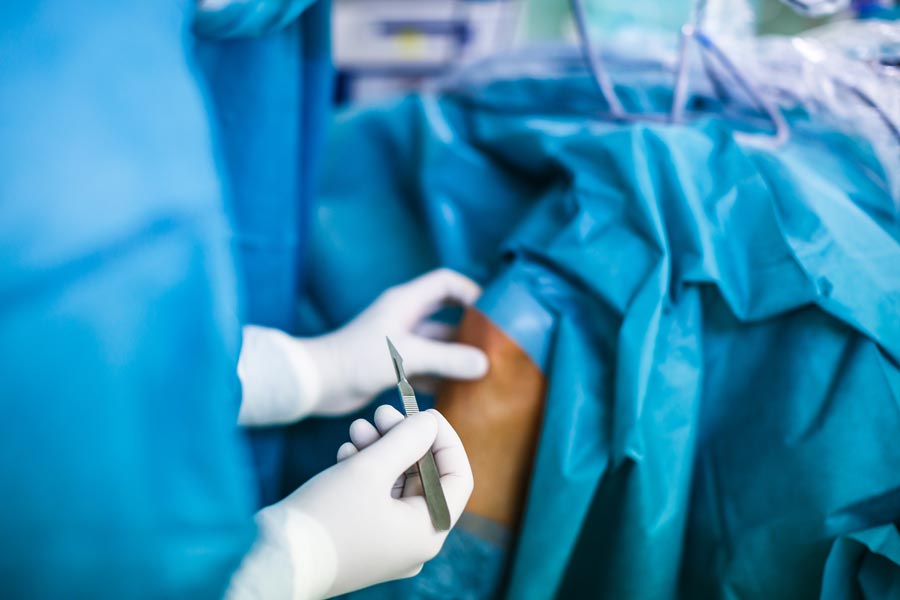
Quadriceps Tendon rupture repair is a surgical procedure that involves reattaching the tendon that is torn apart to the knee cap. It is achieved through drilling small holes in the kneecap through which sutures are made to pull and hold your tendon in position. Prompt repair of the tendon ensures better outcome, as prolonged damage may result in scarring and tightening of the tissue.
Indications
The treatment predominantly depends on the extent of damage, and other factors, such as age and previous level of activity.
Partial rupture of the quadriceps tendons may be treated using conservative treatment options. They include immobilization, straight leg rise followed by quadriceps strengthening and range of motion exercises. Surgical repair is recommended when the pain persists and extension restoration fails even after extensive treatment using conservative methods. It is also considered during acute quadriceps tendon ruptures, chronic complete quadriceps ruptures and for partial rupture associated with tendon degeneration. Surgical repair is successful even if it is performed one year after the injury.
How is the procedure performed?
When surgical repair is recommended, you are provided with specific procedural guidelines for successful treatment.
Pre-procedure care
- Follow the doctor’s guidelines regarding the usage of regular medications.
- Avoid using over the counter pain relieving medications, at least seven days before the surgery.
- Stop eating or drinking anything prior to the surgery as recommended.
- Make arrangements for someone to drive you home after the surgery.
- Avoid smoking at least a week before your surgery in order to reduce your risk for infections.
On the day of the surgery
- On the day of the surgery, you will have to report to the hospital at your scheduled time
- Remove any jewellery or other accessories, such as glasses etc.
- You may need to change into a hospital gown
During the procedure
- You are made to lie on your back on the operating table and the procedure is performed under local or general anesthesia.
- Your leg is positioned to allow visualization of entire quadriceps tendon during the procedure.
- The incision is made corresponding to the results obtained from the diagnosis.
- Sutures are placed in the torn tendon and are passed through the drill holes in the kneecap to reattach the tendon.
- The sutures are tied at the bottom of the kneecap after ensuring the right tension in the tendon and the position of the kneecap.
- In some cases, when the tendon is too short due to prolonged damage or underlying condition, a graft tissue may be placed to obtain the desired length of the tendon.
- The surgeon may consider placing sutures or cables to provide extra protection to the repaired tendon during healing process.
- A new development in the procedure avoids making drill holes in the kneecap by using small metal implants (suture anchors) to achieve tendon repair.
- A cast or immobilizer may be placed to support and protect the repair during healing process.
Post-procedure care
- You may need to stay for at least one night in the hospital that may extend depending on your condition.
- Follow instructions regarding pain medication and icing as recommended for pain management.
- Follow instructions regarding movement restrictions and precautions carefully to avoid complications.
- Supporting sutures or cables may be removed around two weeks post-surgery.
- Weight bearing crutches may be recommended to support you while walking.
- Once the brace is removed, strengthening exercises will be recommended to enhance recovery.
Outcome
The treatment success depends on several factors such as extent of damage and prompt treatment. It may take at least four to six months for complete recovery. Majority of the people can normally perform their daily activities and return to work. Returning to sports activities may depend on the type of sport, age and severity of the injury. Following post-operative rehabilitation is important for better and successful outcome.
References
- https://journals.lww.com/techortho/Abstract/2019/06000/Suture_Anchor_Repair_of_Quadriceps_Tendon_and.14.aspx
- https://emedicine.medscape.com/article/1249621-treatment#d10
- https://www.uwhealth.org/files/uwhealth/docs/pdf6/SM_pat_tendon_quad.pdf
- https://orthoinfo.aaos.org/en/diseases--conditions/quadriceps-tendon-tear/
- https://www.ncbi.nlm.nih.gov/pmc/articles/PMC5766257/