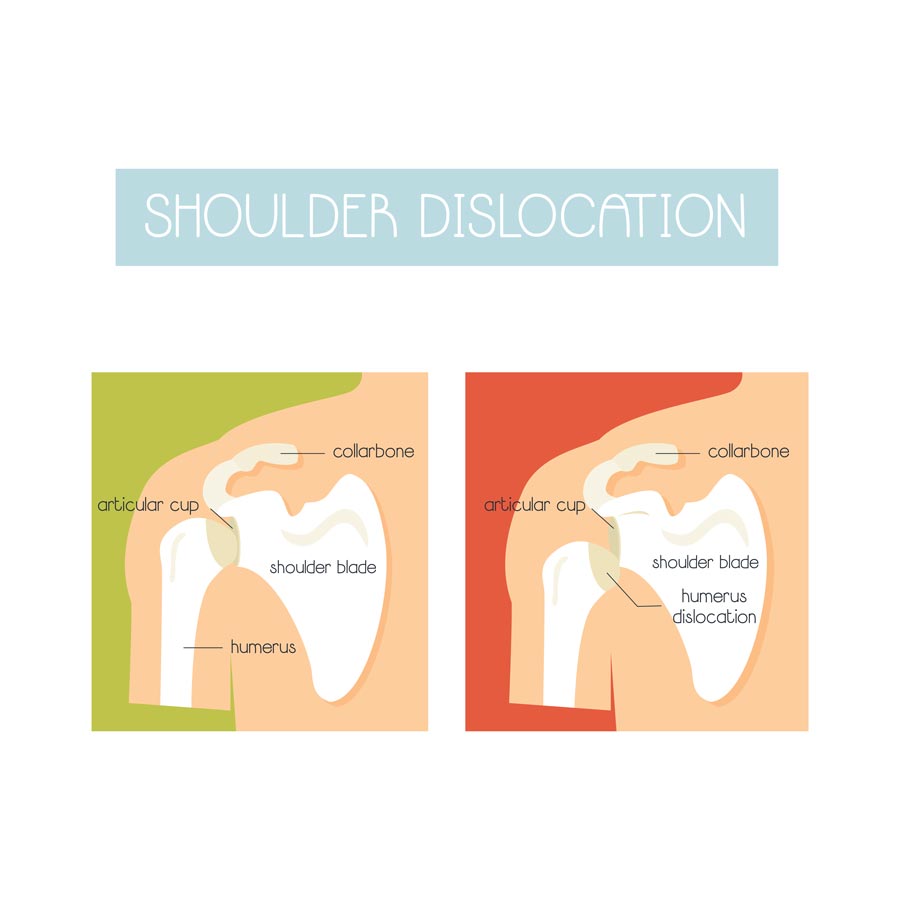
As the name suggests, shoulder instability refers to inability of your shoulder joint to remain intact. More appropriately, the head (ball) of your upper arm is unable to stay within the socket of your shoulder.
Many structures surrounding your shoulder joint, such as linings of the joint, ligaments and cartilage, helps in balancing the ball tightly within the socket. When these structures are stretched or injured, the integrity of these structures is disturbed leading to shoulder instability.
What are the symptoms of shoulder instability?
People with shoulder instability often feel that their shoulder is lose or may slip out from the joint. In most of the cases, individuals with this sensation may experience pain, which get worse with any activities of the arm.
Occasionally, the person may experience numbness or tingling sensation in the arm, which may accompany the following symptoms:
- Swelling
- Bruising
- Clicking
- Decreased range of motion
- Visual deformities like shoulder appearing hanging down and forward or a large depression
- Repeated episodes of the shoulder giving out or slipping away from the joint
What are the causes of shoulder instability?
Shoulder instability may occur due to previous trauma of the shoulder joint. Sudden trauma may lead to shoulder dislocation (a condition in which the upper arm dislocates from the shoulder socket). During this episode, the surrounding structures of the shoulder joint may become stretched, detached or torn. When the joint is fixed back in the place they may heal in a stretched or loose position. This may increase the risk of shoulder instability in future.
The causes for trauma may include:
- Involving in contact sport such as skiing, football
- Falling with an outstretched arm
- Falling down from stairs or any other household activities
- Meeting with any road accident
Other factors that may increase the risk of shoulder instability include:
- Involving in any repetitive overhead motions, such as swimming or throwing sports
- Having any genetic conditions that may lead to loose ligaments or joints
- Having a history of shoulder fracture
How is the shoulder instability diagnosed?
The diagnosis for shoulder instability include reviewing of a medical history and a physical examination. The physician may review your previous injuries, symptoms, and ask about the situations during which the pain become intense.
A Physical examination is done to check for the tenderness, strength and mobility of the affected shoulder. Specific tests such as load-and-shift test, the relocation test, the drawer test or the sulcus test are helpful in assessing the stability of the shoulder.
Imaging tests
Imaging tests are done to identify other related conditions and confirm the diagnosis. They may include:
X-ray: X-rays provide images of dense structures like bones. They are helpful in identifying injuries to the bones that may lead to shoulder instability. They are also used to identify weather the shoulder joint is dislocated in the past, causing instability in the shoulder joint.
Magnetic resonance imaging (MRI): MRI provides more detailed images of soft tissues in the body. It helps to visualize any damages related to the structures around the shoulder like ligaments and tendons.
Arthrography: An arthrography is occasionally performed when further evaluation of the tissues is needed or when a person is suffering from unexplained pain.In this test, a special contrast dye is injected into the joint and a computed tomography (CT), MRI or a real-time X-ray is performed to produce images of the joint. It enhances the visualization of small internal structures and helps in accurate diagnosis.
How is shoulder instability treated?
The treatment depends on the extent of shoulder instability and the conditions that may cause it such as injuries. Often, shoulder instability is treated using non-surgical options, while surgery may be considered when your ligaments are severely torn or stretched.
Non-surgical treatments
Rest: When your shoulder is dislocated due to instability, it is important to rest and avoid any activities that may aggravate your symptoms.
Immobilization: Sometimes the physician may recommend a brace or sling to restrict the motion until the pain subsides.
Medications: NSAIDs (nonsteroidal anti-inflammatory drugs) such as aspirin or ibuprofen helps in reducing pain and inflammation.
Physical therapy: Once the pain and inflammation are reduced, your doctor may recommend strengthening exercises. A physical therapist helps in designing a suitable exercise regime that helps in strengthening your shoulder muscles that further helps in increasing the stability of the shoulder joint.
Surgical treatments
Surgical stabilization is necessary when the symptoms continue to interfere with daily activities or the personal goals. It involves tightening the stretched ligament tissues by reattaching the torn ligaments. This helps in stabilizing the shoulder joint in place. It can be either done using arthroscopy, performed through small incisions or open surgery, which involves operating through a large incision. Post-surgery, your shoulder may be immobilized using a temporary sling, after which strengthening exercises are recommended gradually to improve the range of motion, strength and control of the muscles around your shoulder joint.
What is the prognosis for shoulder instability?
The recovery from surgery depends on the type of procedure. The range of motion usually returns the day after the surgery; however it may take six to eight weeks to obtain complete range of motion. Returning to sports depends on the personal goals, but it may take one year for high-level athletes to get back to their normal regime. It is important to stay committed and follow the recommended post-recovery treatment plan for better and quick recovery.
References
- https://www.hopkinsmedicine.org/health/conditions-and-diseases/shoulder-instability
- https://familydoctor.org/condition/shoulder-instability/
- https://orthoinfo.aaos.org/en/diseases--conditions/chronic-shoulder-instability/
- https://www.aafp.org/afp/1999/0515/p2773.html
- https://my.clevelandclinic.org/health/diseases/17473-shoulder-instability
- https://www.orthogate.org/patient-education/shoulder/snapping-scapula-syndrome