All the bones in the body are covered with cartilage (a connective tissue) at their ends which reduces the friction between the bones and helps in a smooth movement of the joint. The degree of roughness in joint in so smooth, that man has not been able to replicate that miracle of nature. Although cartilage is a tough and flexible material, it is prone to damage. At some point or the other, most people suffer from cartilage damage commonly involving the weight bearing joints. The other less commonly affected joints may include, ankles, elbow, wrist, hand and shoulder.
What is cartilage damage?
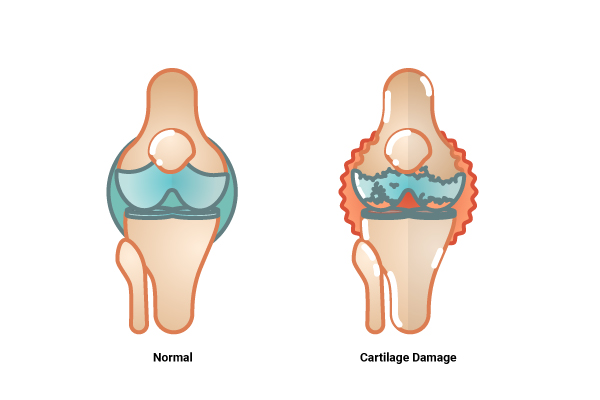
Cartilage is the fine, rubbery tissue that acts as a smooth moving surface across the joints and as a cushion between the bones. Its damage can lead to pain, swelling, and stiffness of the associated joint.
What are the symptoms of cartilage damage?
The common symptoms of cartilage damage involving a joint are:
- Joint pain that occurs even while resting and worsens with activities or when the joint is under stress
- Swelling that develops after a few hours or days after cartilage damage
- Joint stiffness and reduced movement
- Joint locking due to the breakage of a piece of cartilage.
- Clicking or grinding sensation in the joint
What are the causes and risk factors of cartilage damage?
Cartilage damage can occur due to the following reasons:
- Cartilage has no blood supply, hence damage does not undergo a reparative process; cartilage survives by getting nourishment from the normal synovial fluid.
- A direct blow to the joint due to automobile accidents or in people who participate in high impact sports. Sportspeople who constantly pound their joints with high impact for eg football are at a higher risk of developing cartilage damage
- Wear and tear of the cartilage due to prolonged exposure of the joint to stress. This is more common in obese people due to high physical stress associated with excess weight and can lead to an eventual loss of cartilage
- Lack of movement of the joints for prolonged periods can also increase the risk of cartilage damage
How is cartilage damage diagnosed?
Symptoms of cartilage damage are very similar to other joint conditions such as a sprain or ligament damage. Therefore, a proper diagnosis can be challenging and needs the use of modern noninvasive and invasive tests.
The doctor carries out a physical examination of the joint and orders for one or more of the following diagnostic tests:
- Magnetic resonance imaging (MRI) uses a magnetic field to create detailed images of the internal structures. However, an MRI sometimes cannot detect cartilage damage
- Arthroscopy, a form of keyhole surgery, uses a tube-like camera known as arthroscope which is inserted into the joint through a small cut to investigate and repair the cartilage. Arthroscopy can also determine the degree of cartilage damage.
What are the treatment options?
Minor cartilage damage is usually self-limiting and gets better within a few days to weeks even without treatment. However, severe cartilage damage does not improve without treatment and can eventually lead to wear and tear of the joint.
Moderate cartilage damage may need physiotherapy or the use of non-steroidal anti-inflammatory drugs (NSAIDs) such as ibuprofen. Physiotherapy involves certain exercises to strengthen the muscles supporting the joints, thereby, reducing the pressure on the joint cartilage. It is also useful for early recovery after surgery. Sometimes steroid injections may be necessary.
If the patient does not respond to the above treatments, then surgical intervention may be necessary. Several surgical techniques are available and the choice of the technique is based on the factors such as the age of the patient, level of activity, size of the lesion, etc. These surgical options include:
- Drilling tiny holes (i.e. microfractures) in the exposed bones to assist in the growth of a new cartilage
- Replacing the damaged cartilage with a healthy one taken from another part of the joint. This method is not effective when the damage is more extensive as in the case of osteoarthritis
- Rotational realignment of bone to bring the non-damaged part into the most stressed and used area
- Allograft cartilage replacement
- Lab grown cartilage cells can be grown from cells harvested from a non-weight bearing area of the joint and re-implanted
- Replacing the entire joint with an artificial joint may be necessary in most severe cases
Self-care
For minor joint injuries, the initial treatment includes taking certain self-care measures such as:
- Giving rest to the affected joint especially during the first 2-3 days after injury and gradually increasing the activities over the next few days
- Using supports such as leg braces or canes to protect the affected area and prevent further injuries
- Applying ice packs to the joint for about 15-20 minutes for 4-5 times each day for the first 2-3 days
- Keeping the joint in an elevated position whenever possible to reduce swelling
- Taking painkillers such as paracetamol, ibuprofen, etc.
Prevention
It is not possible to completely prevent the risk of developing cartilage damage. However, these measures can reduce the risk of developing the condition:
- Losing weight (for obese people) to minimize the stress on the joints
- Carrying out regular physical activities to maintain the health of the joints
- Injury prevention measures